I don’t buy prints from fellow photographers, but while reading the Huffington Post I came across this article titled; o-homeless-portraits-ten-900Photo Series Captures The ‘Beauty In Every Line’ On The Faces Of LA’s Homeless. There is no better way to describe my reaction to those images then to say “Impact”. I stopped and gave my full attention to this photographic essay of black and white images named  “The Elders”. Photographer and artist Aimee Boschet had captured the humanity and dignity of homeless people in America. I didn’t just look at Aimee’s work, I studied it, and absorbed  every face. When I came across image number ten of an elderly black man in a straw hat I was gobsmacked.

I ordered that print and it came today. That online image cannot be compared to the 8×10 print that I held in my hands.The elegance and wisdom of this man who life’s journey is written in every line of his face provoked an emotion that  is hard to describe. It wasn’t sadness or pity but connection. In spite of his station in life, this image of grace by Aimee is a reminder that we are all brothers and sisters in this life and that we all have a story to tell. My hat is off to Aimee Boschet who’s essays is not about lost souls in a cruel world but is an embodiment of humanity that reveals their soul, even Aimee’s own soul.
FYI: 
According to the Institute for the Study of Homelessness and Poverty at the Weingart Center, an estimated 254,000 men, women and children experience homelessness in Los Angeles County during some part of the year and approximately 82,000 people are homeless on any given night. Unaccompanied youth, especially in the Hollywood area, are estimated to make up from 4,800 to 10,000 of these.
  • 33% to 50% are female.  Men make up about 75% of the single population.

  • About 42% to 77% do not receive public benefits to which they are entitled.

  • 20% to 43% are in families, typically headed by a single mother.

  • An estimated 20% are physically disabled.

  • 41% of adults were employed within last year.

  • 16% to 20% of adults are employed.

  • About 25% are mentally ill.

  • As children, 27% lived in foster care or group homes; 25% were physically or sexually abused


“I just really want to tell you right now Enzo, that it is extremely plausible that you have created your own world and the illusion is that you are a neurotic mess because your mother was a neurotic mess. You think to much and feel to little, now go home and eat some prosciutto, drink some vino and take a nap.”

My friends, jump-start your day with a good night’s sleep with the comfort and quality you get from our single steel frame beds. You are guarantee with a life time warrenty to wake up refreshed and ready to roll out of your slumber to start a fun filled day of adventure. To make more of your space, go for the twin beds seen here. All our beds are bolted to the concrete sidewalk with built-in storage giving you space to chain your shopping cart or with the roomy space underneath to slide your backpack underneath. Our urban beds also give you the option to use your backpack, Von’s plastic bags or jackets as a pillow for your catnaps. And we have everything else for your street needs; steel slates for circulation, imaginary firm mattress for your back, and a duvet that you wear. All this to complete your bed in style. We are your Urban Outfitters courtesy of the Los Angeles Homeless Services Authority.

All kidding aside. When one has exhausted all resources and is reduced to the insane condition of toting a small travel bag, aimlessly riding buses, selling plasma, eating in soup kitchens, walking in a dream, sleeping in shelters and parks, and knowing that going to jail is a step up on the social ladder, this is homelessness.

“To me, photography is an art of observation. It’s about finding something interesting in an ordinary place… I’ve found it has little to do with the things you see and everything to do with the way you see them” – Elliott Erwitt

Street Photography is like catching butterflies, you run around scanning the horizon trying to catch that magic moment of interaction. With patients and tenacity, the nectar of your efforts presents itself unexpectedly. With stealthy sequence of movements, you position your lens ready to capturing the allusive moment. The planets are aligned, the decisive moment is captured  becoming an artifact of time that will never exist again. Well, that’s if you don’t stage the shot.

Carl

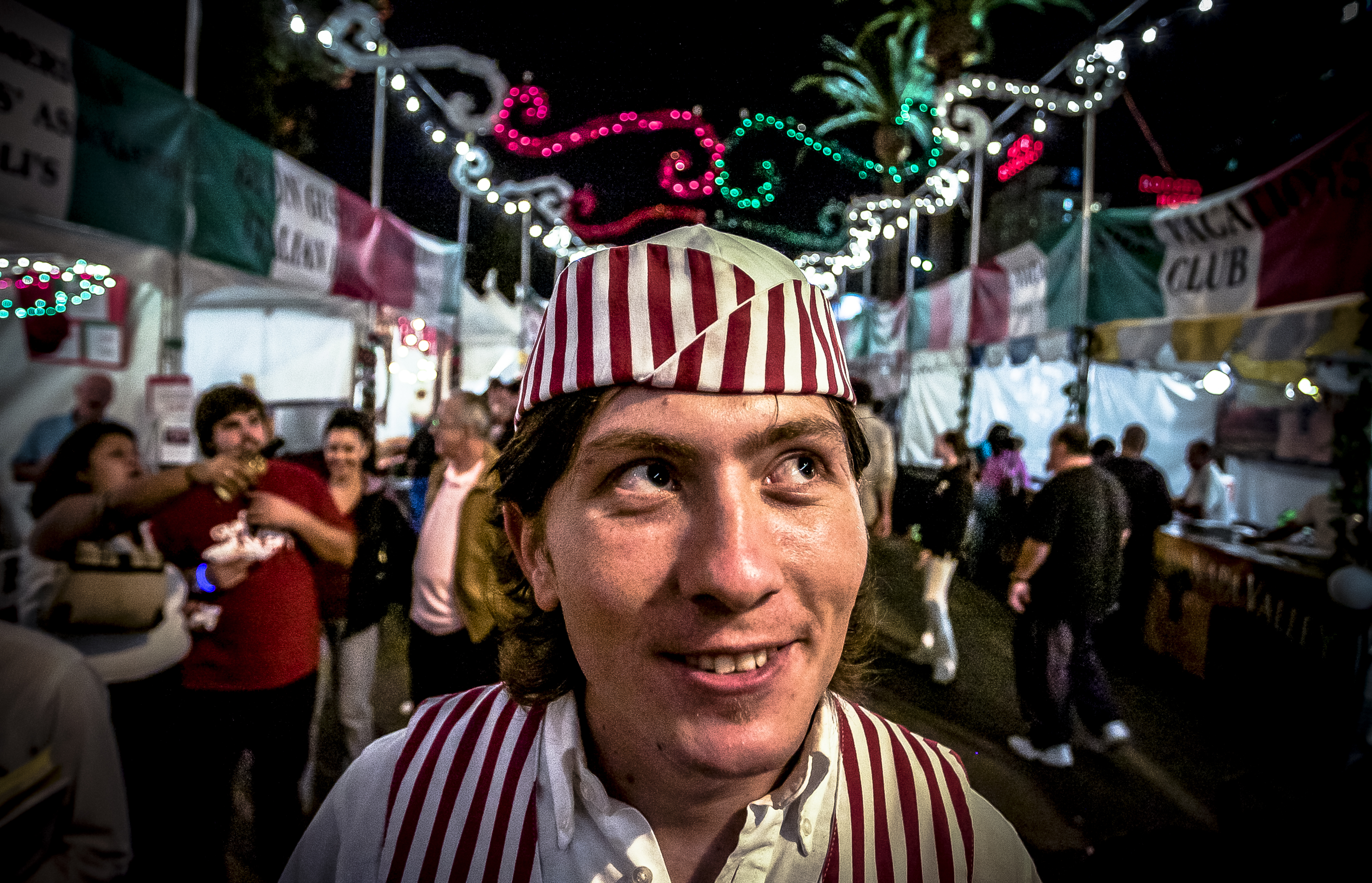
“I’m not sure if it the zest for life that I have or just the carbonation… my friends say that I have a bubbly personality. Oh geez ! People that say you have a bubbly personality… chances are you’re not attractive. I don’t think I’m ugly, I have a great smile, good hair, a positive attitude and I’m a Gemini. Did you know that we Gemini’s are gentle, affectionate, curious, adaptable, with an ability to learn quickly and exchange ideas openly. The downside of being a Gemini is nervousness and indecisive….wait a minute, indecisive…Coca-Cola or Pepsi ? Oh ! it’s not important. The only thing I don’t like about being a soda jerk is the paper hats. I mean they tear easily after you sweat and they never fit right. I don’t throw my paper hat’s away I keep them and make origami zebra’s..you know, the strips on the hat and all. Origami zebras are more difficult to fold than origami cranes. My paper hats are perfect for folding for zebras. It took me forever to get the lines of zebra stripes vertical and not horizontal. My zebras reminds me of the old adage: Not everything is black-or-white, or in my case red and white. The world isn’t black-or-white in the zebras world either. I once read that the symbolic meaning of  zebras are the masters of balance, a symbol for individuality, the spiritual significance of knowing yourself, and the magic of illusion. So, I may have a bubbly personality and be optimistic by nature but don’t judge me by my stripes, remember I’m a Gemini.”

Chapter Six

Music is a safe kind of high – Jimi Hendrix

It’s not that I’m a snob about music but any world traveler will tell you that one of the most essential items in your rucksack is your music. My choice of tunes has become the soundtrack for many of my journeys, often saving my sanity. I can attest that there is nothing better then listening to your iPod on a transatlantic flight, it evokes a wonderful state of being that takes you away from the crying babies and exasperated mothers. Music has protected me from exasperation when Egyptian wedding parties have still been going strong at two o’clock in the morning, as well as helping me pass days (not hours) while once waiting for a flight out of Kabul.

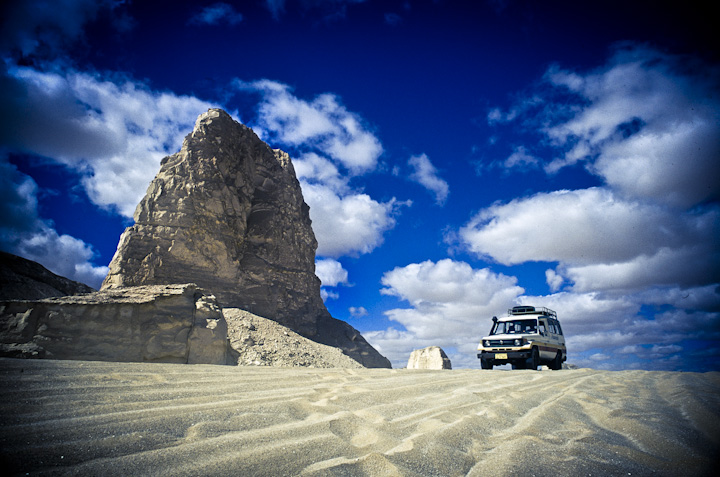
              For me, Justin Bieber’s mindless pop just doesn’t lend itself to the experience of tearing across sun-bleached sands in the Sahara desert in a Toyota Land Cruiser. The Clash’s ‘Rock the Casbah’, however, does a terrific job and always sets the mood. I have collected CDs from souks, bazaars, back alley kiosks and hotel lobbies; I’d like to think that, as a result, my taste in music is eclectic. You’ll find Middle Eastern dance, Bollywood, Japanese pop, electronica, soul, rock, tango and Neapolitan ballads on my iPod. 

              Like a still image, a song can transport you back to a moment in time that has been forgotten: a cognitive process that scientists have tried to understand for a long time. For instance, during the wild fires of southern California in 2009 I had a very real flashback when Shakira’s song ‘Whenever, Wherever’ blared out from the radio while I was driving along the Glendale freeway. Combined with the sight of the burning hillside, the fumes of diesel and the ‘thump, thump, thumping’ of the helicopters overhead I was immediately transported back to the Bagram airbase in Afghanistan.

              I see music as a synthetic acid that enhances flashbacks of our memories. Scans of the brain have shown that when people listen to music, virtually every neuron becomes more active, which may explain how I’ve overcome a learning disability, dyslexia and attention deficit disorder. Music forces me to focus, which keeps my ADD at bay. Growing up, my parents could never understand why I would play music when reading or studying; they’d just shout at me to turn the record player or radio off. 

              Once I sit down and play my music I fall into a Zen-like state; my brain slows down to a crawl so that I can concentrate. If it were not for music I would probably be selling used furniture in Tulsa, Oklahoma. 

              In all societies – with the exception of just one, that I know of: the Taliban – music’s primary function is collective and communal, to bring and bind people together through singing and dancing, should their culture allow. Humans have been making music since those first cavemen’s campfires.

              In Kabul, Afghanistan, I spent an afternoon eating lunch that had been cooked on the sidewalk, in front of a carpet store on Chicken Street. The owner and his son stayed and had lunch with me so that they could practice their English. When Kabul was under Taliban control, paper bags, white socks, kite-flying and music were forbidden. This was serious oppression; for instance, possession of a paper bag constituted the death penalty. If they viewed that so severely, imagine what they’d have done if a flash mob broke out to Survivor’s ‘Eye of the Tiger’ – the Taliban would have nuked all of Chicken Street.  

Flower Street, Kabul, Afghanistan

              To celebrate my host’s and his son’s newfound freedom we played ‘Jump Around’ by House of Pain on his chrome-trimmed ghetto blaster that he’d kept hidden from the Taliban. It must have been very amusing for the ISAF (International Security Assistance Force) troops to see a couple of Afghans and one big white guy jumping to the beat of the music in front of the old carpet store. To this day, when I hear ‘Jump Around’ I can smell the pilaf cooking, feel the heat of the day and, in my mind’s eye, see the physical expression of freedom on the owner’s face and that of his son’s, as they danced with sheer joy. 

              Prior to a shoot in Egypt I listened to singer Amr Diab which gave me some insight into modern Egyptians’ taste and a clever way to win over friends. I phonetically learned Amr Diab’s hit ‘Nour El Ain – Habiby’. Arabic was not a language I grasped quickly; I know a few phrases like ‘tiizak hamra’: ‘Your ass is red’ (i.e. like a monkey’s); or ‘moxxu gazma’: ‘His mind is (as low and dirty as) a shoe’, a bitter insult. Still, I persevered and mimicked ‘Habiby’ before leaving the States.                                                                                                                                                              

              Once we landed in Cairo we immediately started shooting. On a production like that there’s not much time to build a friendly relationship with your Egyptian fixer, crew members or driver. Despite the language barrier, we were all very courteous to each other and worked together really well. On day four of the assignment, we were travelling from Cairo to Giza by van; Abubak, our driver, pulled a cassette tape from a black box that he was very protective of, because it contained his personal collection of music. I was in the back of the van as the Egyptian crew sat up front, smoking Cleopatra cigarettes. The intro began to ring out and I felt butterflies in my stomach. Amr Diab sang the first lyric. I stood-up (as much as I could in the van) and belted out, ‘Habibi ya nour el-ain, ya sakin khayali, a’ashek bakali sneen wala ghayrak bibali (translation: My darling, you are the glow in my eyes, you live in my imagination, I adored you for years, no one else is in my mind). I then sang the chorus: ‘Habibi, Habibi, Habibi ya nour el-ain’ (My darling, my darling, my darling glow in my eyes).                                           

              I swear to God, one of the crew member’s cigarette dropped out of his mouth, and I could also see in the rear view mirror Abubak’s eyes widen – he nearly rear-ended the Cairo taxi in front. There was a moment of shocked silence – this big white guy from California was singing one of their most popular songs. They began to clap in unison to the beat of the song; one by one they stood up and held their hands high, swaying their hips, as we all sang ‘Habibi, Habibi’. The remaining seven days of our shoot were flawless. Every evening we came together and smoked shisha, played dominos and learned curse words in each other’s language. At the end of the shoot, and before checking in for the flight back to the States, we all stood in the Cairo International Airport parking lot to say our goodbyes and so I could pass out their payment and traditional bonuses. I noticed Abubak walk from the cab of his van with something wrapped in newspaper. He presented me with a gift: my very own hookah and shisha.                                                                                                                                               Surrounded by the Egyptian crew, tears filled my eyes as I accepted their gracious offering. We’d become as close as brothers through our common love of music. As we said our goodbyes I couldn’t hold it in any longer and I openly sobbed as I hugged each of the big, burly, bearded men. They, too, began to weep as I walked away and boarded my flight.                              

              I missed out on securing a bulkhead seat in coach and found myself wedged in a middle seat at the back of the plane. The seat had only enough space for a tiny derriere, which I don’t have – I swear, my toilet seat back home in Burbank was bigger. My legs were cramped up against the gray folding tray hanging from the seat in-front of me that refused to stay up, which seems to happen on every overseas flight I take. I should file a report to Amnesty International that United Airlines commits acts of torture by kneecapping captive consumers. 

              The in-flight movie was one I’d seen before: a chick movie, ‘Sleepless in Seattle’. It was time to escape into my world. I settled myself as much as I could by placing a pillow between my knees and the seat in-front of me. With my earplugs in and my iPod tuned to my favorite artist, Natacha Atlas, I opened a dog-eared page of my book: The Teachings of Don Juan, by Carlos Castaneda. Having lived in the Sonoran desert of the American southwest, and after working in the Sahara desert, I have an affinity with space, sand and time. As an anthropologist, Castaneda wrote that Don Juan Matus, a Yaqui Indian and shaman, was an expert in the cultivation and use of various psychotropic plants, (specifically, magic mushrooms, angel’s trumpet and peyote) all found in the Mexican deserts. While under their influence, Castaneda reached a transcendental state. At cruising altitude, with the monotone whine of the jet engines and the murmurs of fellow passengers, Natacha’s song, ‘Ya Weledy (My Child)’ began and I hoped to gain similar escapism. The music then turned to an Arab symphony; in my mind a curtain rose and I played back the last few days with my Egyptian friends as Natacha sung: ‘Don’t forget your friends, don’t forget your friends. And those who think of you, and those who think of you, you don’t know what is in front of you. Don’t stray from the path.’                             

          My own hypnotic drug – my music – was starting to kick in and I felt serenity, wedged inside my seat miles from the ground, incarcerated in a metal box. The track changed to Anthony Newley’s ‘What kind of fool am I?’ and I had a vivid flashback of my friend, Ya’akov, whom I worked with in Israel as we searched for a money shot….

*****

The passenger window next to me was tinted yellow from years of exposure to cigarette smoke. Running down the middle of the window was a vertical crack in the shape of lightning; it was stuck halfway which allowed a blast of hot air to penetrate the cab, bringing with it familiar smells of diesel and earth. As the terrain charged by, I idly wondered which biblical figures had walked this ground, and which battles from the Old Testament had been fought there. But it was difficult to ponder such searching questions when my Israeli driver, Ya’akov’s, radio-cassette player screamed ‘What kind of fool am I?’

              With both hands on the wheel, and an ever-present Marlboro dangling from his lips, Ya’akov belted out the tune, over-enunciating each lyric. A man of small stature, Ya’akov was built like a brick house, with hands like baseball gloves and eyes blue and clear. 

              For some, pop music is considered to be the demise of civilization but for Ya’akov, it was a blessing. Ya’akov embraced western culture by teaching himself English from the Billboard’s Hot 100 music chart – it was the reason why he strained so hard to pronounce each lyric. Although his accent was definitely Israeli, it switched to a bad Elvis impersonation when he cursed aloud, such as when the undercarriage of his truck scraped the limestone rocks in the road. He also had difficulty with slang, such as when we referred to the ‘walkie talkies’ we used on location. He called them ‘okie dokies’. So used to his description, I still find myself calling them ‘okie dokies’ even now. 

              Ya’akov relayed his military service history during our trip. He was a veteran of the Six-Day War and witnessed Israel’s history from the front lines. He added that the Beatles released ‘Sgt. Pepper’s Lonely Hearts Club Band’ only days before the battle. He especially liked ‘When I’m 64’. 

              It was May 1967 when the Egyptian president, Gamal Abdel Nasser, expelled the United Nations’ Emergency Force from the Sinai Peninsula, including the Suez Canal. Egypt subsequently blockaded Israel’s southern ports of Eilat and the Gulf of Aqaba, preventing shipments of Israel’s oil imports. Nasser also had a strategic alliance with Jordan and Syria, with additional military support from Iraq, Saudi Arabia, Sudan, Tunisia, Morocco and Algeria. Egypt had amassed a thousand tanks and nearly a hundred-thousand soldiers on the Israeli border. On June 5, 1967, Israel launched a pre-emptive attack against Egypt. Ariel Sharon commanded the most powerful armored division on the Sinai front, which Ya’akov’s unit was part of. Ya’akov, a machine-gunner, fought in that battle, but not before his unit was held back due to landmines and Egyptian tanks. I can only imagine that while he waited for the orders to move out, Ya’akov was drinking coffee, smoking cigarettes and hoping to make it to 64.

              General Sharon broke away from his plan of attack and ordered his troops to follow a camel path through the sand dunes, thus avoiding thousands of landmines and with the intention of surprising the Egyptians. Ya’akov was happy to have just survived the war. He now drove film crews around Israel and sold cartons of Marlboros to the Bedouins. 

              We were on an old dirt road, somewhere off Highway 79, near Nazareth. Ya’akov maneuvered around bombshell-size potholes; his truck, filled with our camera gear, swayed almost rhythmically to the cassette player. The goal was to find an appropriate filming location in the Israeli outback, one without power lines or any evidence of the twenty-first century. I let my driver – and serendipity – find the money shot. 

              The first time ‘happy chance’ occurred was when I shot a documentary about the Dead Sea Scrolls. We’d traveled to the cave in Qumran where the scrolls were found by a Bedouin shepherd in 1947. With that segment of the documentary done, and with no further obligations, I put my headphones on and succumbed to Esquivel (which is great travel music). I let fate and inevitability take us down unmarked dirt roads. Hidden away were miles of beautiful, sweeping terrain, perfect for shooting stills and B-roll for the documentary. Since that shoot it has become a ritual to wander aimlessly about our location.

              True to this tradition, Ya’akov found a spot and pulled over. He got out a small backpack stove and proceeded to make us coffee. We sat on the back tailgate, smoking cigarettes and stirring our thick, black coffee.

              ‘Ya’akov,’ I said.

              ‘Yes, David?’

              ‘How about another song?’ 

              Without blinking, Ya’akov bellowed, ‘In-a-gadda-da-vida, honey, don’t you know that I love you? In-a-gadda-da-vida, baby, don’t you know that I’ll always be true?’

              As he stood in the middle of the old dirt road in the outback of Israel, Ya’akov mimicked playing a Vox organ in D-minor while belting out his tune. ‘Jesus,’ I thought, as I recognized the melody by Iron Butterfly. And then it hit me: the song came out in May of ‘68, right after the dust settled from the Six Day War – around the time Ya’akov started learning English. 

              As the sun set and Ya’akov rolled out the hits, there was nowhere I would rather have been. I shouted out, ‘Hey, Ya’akov…hand me your okie dokie. I’ll charge it for you.’

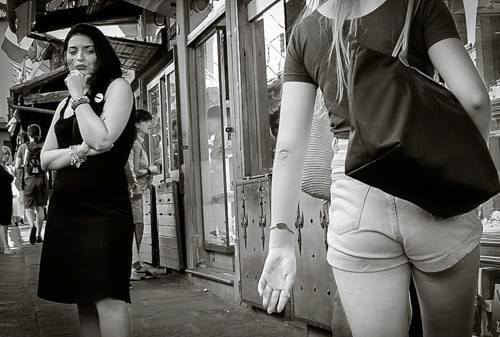
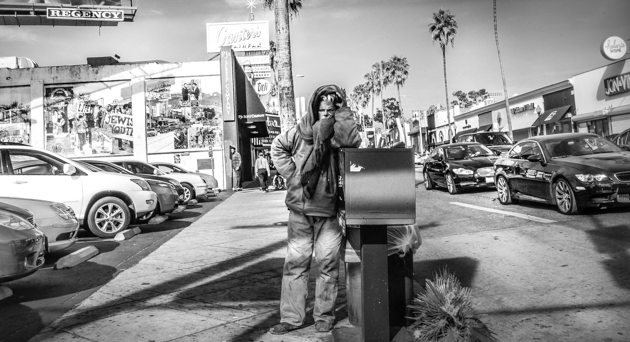
Posing_As she rested her elbow on an old L.A. Weekly newspaper bin, she continue to smoke from a stubby discarded cigarette.

She then tells me,

“I have more than once made contact with the pavement and it wasn’t so gingerly either, the last time was at the corner of Fairfax and Beverly.”

“She paused, took the last drag of her cigarette and dropped it on the concrete between her battered boots, strange how the world looks from the ground up, I once saw an ostrich too……. all well…. life has no obligation to give us what we expect.”

Heather Newman is the founder and CEO of Creative Maven, a virtual marketing consulting firm that brings c-level strategy, inspiration and creativity to marketing teams, startups, enterprise businesses and individual artists. She has produced thousand of events, campaigns and experiences in the high-tech and entertainment industries. She is also the Co-Founder and Chief Marketing Officer of Content Panda, a high tech business dedicated to creating products that deliver a superior user experience that drive value to businesses. She is also a Microsoft MVP for Office Apps and Services. Heather-Newman-Headshot.jpg

In this episode Heather interviews Dave Banks, award winning documentary film-maker, writer, and photojournalist.  Tune-in to hear their conversation on: “I knew the struggles.” – Growing up with a single working mother inspired Dave to get involved with the Women’s Movement and how he uses his connections to amplify the message. “Life in the City of Angels” – Dave’s passion for sharing stories with his work and the books he is working on. “Nobody really knew what dyslexia was.” – How Dave’s struggle with dyslexia as a young man and an understanding teacher led him to photography and documentary filmmaking. “There’s this world over here that they’re not talking about or discussing.” – Dave’s observations as a freelance photo journalist at Standing Rock and the Middle East on how the mainstream news media is failing to deliver real news. “I kinda fell into it.” – How Dave’s work on the Wide World of Sports at ABC led him to work as a freelancer in the Middle East and his experience with PTSD. Visit mavensdoitbetter.com for full show notes, transcripts, and more.

Sahara-Riders

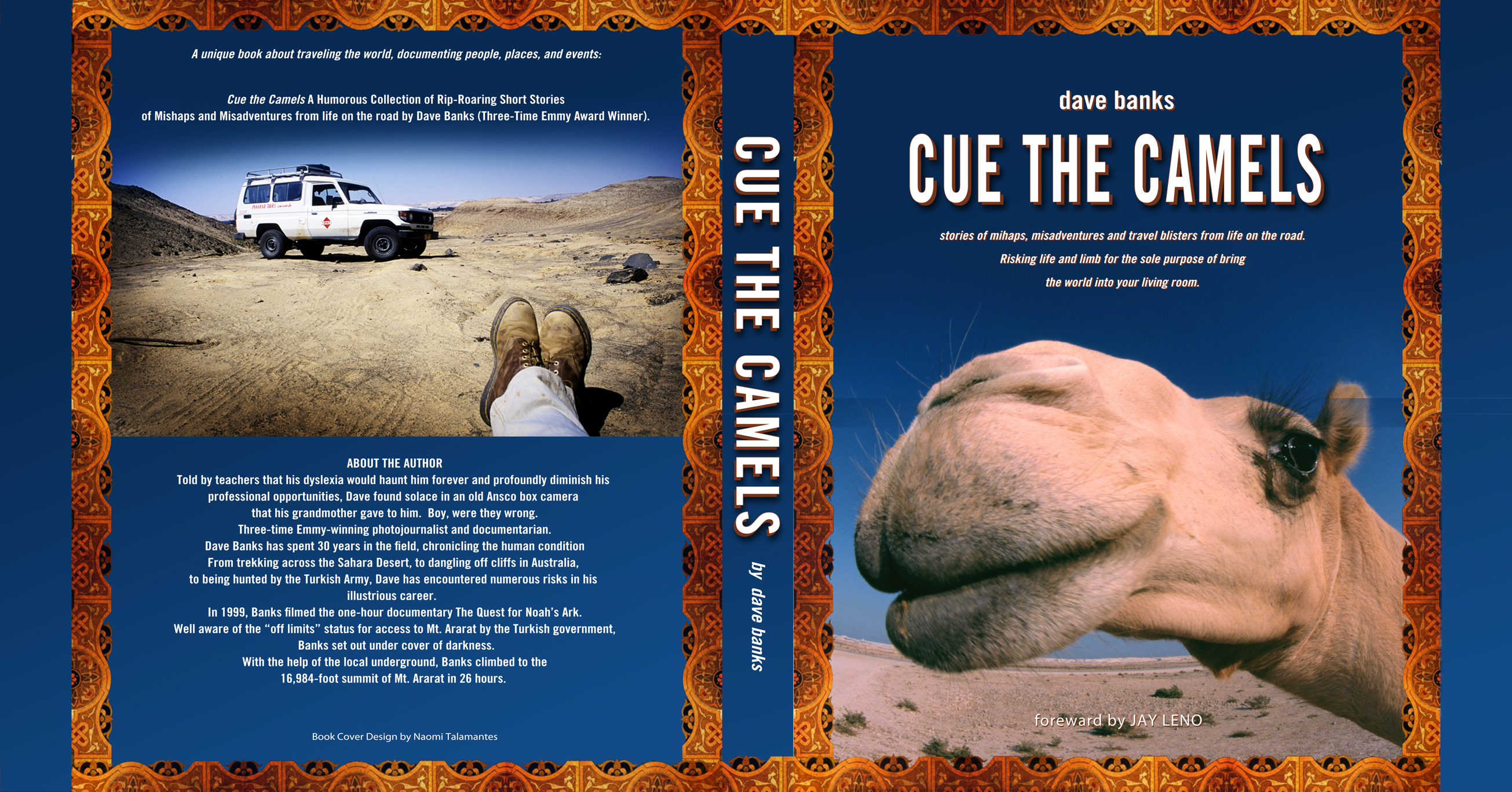
Cue the Camels

by

 Dave Banks

Copyright © Dave Banks. The right of Dave Banks to be identified as the author of this work has been asserted in accordance with the Copyright, Designs and Patents Act 1988. All rights reserved.

FOREWORD by JAY LENO

I wasn’t sure what to expect when Dave asked me to write the foreword to this book. I’ve always known Dave as the guy behind the camera with the very loud laugh. His audible approval of my jokes has always proved wonderful feedback; sometimes, his chuckles would escalate to a full belly laugh that echoed across the stage during rehearsals.

I’d clearly notice Dave’s absence for weeks or months at a time – his giggles only heard in my memories – until, unexpectedly, his distinctive howl would come from behind the camera once again. Dave’s disappearing and reappearing act had been going on ever since I took over the Tonight Show in 1992, but it wasn’t until reading ‘Cue the Camels’ that I learned Dave was freelance – booking out of my show to shoot news and documentaries in the Middle East and North Africa.

As a solo journalist he covered the war in Afghanistan which goes some way to explaining why he always seemed to have a smile on his face. He was just happy to be somewhere he wasn’t being shot at or pursued by a foreign army. He appreciated the warm, comfortable studio and that he was not lost somewhere in a landmine field, however much I like to think it was my jokes and free coffee that kept the constant smile on his face.

Within these pages Dave has written gung-ho, self-deprecating, wildly engaging accounts of his exploits, with all the behind-the-scenes high-jinks that go into shooting news and documentaries across the world.

In his chapter ‘Dog Biscuit and Noah’s Ark’ Dave perfectly describes his decompression from one of his trips back to the Tonight Show: ‘Forty-eight hours ago I was in eastern Turkey, a target of the Turkish army, avoiding the PKK, dodging Kurdish smugglers and circumventing landmines on a goat trail.

Recovering from jet lag, painfully sore calves, busted blisters and jock itch, I was now hobbling about Stage 3 at the NBC studio lot in Burbank, California. I’d picked up a couple of days’ shooting on the Tonight Show with Jay Leno. The guests that night were Martin Short and Mia St. John, the music provided by Santana and Rob Thomas (which I was particularly excited about). The best part of the gig was the perks: free coffee, pastries, camaraderie and good laughs.’

Dave welcomes you to both of his worlds.

I once told Dave, ‘Whatever you do, make it entertaining, and don’t be afraid to make fun of yourself.’ I’m glad to see he took my advice and applied it to ‘Cue the Camels’.


INTRODUCTION

 ‘Doubt consumes the spirit; without risk, our destiny is ultimately written by others.’

‘We were not mentioned in S. E. Hinton’s book, ‘The Outsiders’.  We were the nameless kids from north Tulsa whose economic standing was somewhere between the Socs and the Greasers. We were the nerds, the geeks and socially inept when it came to girls. But, with our parents’ Bell and Howell 8mm cameras, we charged other kids 50 cents to be in our war movies. Our little band of brothers found its place in life.’

~ Dave Banks

While watching the History Channel, you may be captivated by a shot of a majestic sunset in the Sahara Desert; Bedouins and their camels enter the frame and cross your television screen, their black silhouettes strolling across the blaze of the sun. This image burns into your imagination and transports you from your recliner to a place you’ve never been. Then the program fades to black and a Snuggie commercial begins. You ignore the ad and replay that desert scene in your mind. A thought may pop into your head from time to time: just how did they capture that incredible footage?

*****

Have you ever wondered who filmed the rock climber two thousand feet up, dangling from the granite walls of Yosemite? Or considered how a cameraman got those claustrophobic shots deep inside the ancient tunnels beneath the pyramids of Egypt? How about the intense handheld footage of the Los Angeles riots – what kind of cockamamie person would voluntarily put himself into that chaos? Well, I’m ‘that guy’. In this book, I’ll bring you a unique glance into the two worlds I inhabit and the difficulties I’ve had to endure.

Few people realize, that to film documentaries in exotic locations, a cameraman, or ‘shooter’ may be forced to brave blinding sandstorms, the blistering heat of the day, ‘bone-marrow freezing’ nights, as well as experience the sharp crack of gunshot followed by the screaming hiss of bullets as they pass by his head. He’d need to survive the projectile side-effects of eating what some cultures call ‘delicacies’, but what we would simply consider ‘repulsive’.

As a result of being dispatched all over the globe, I’ve embarked on the types of trips few travelers ever experience, and I’ve done this whilst lugging thousands of dollars worth of camera equipment. I’ve risked life and limb for the sole purpose of sharing the farthest reaches of the world for the audience back home. I’ve covered expeditions, mountain climbs, archeological digs, adventure races, civil strife and war. I’ve been shot at; I’ve been lost in the Sahara desert, and I’ve been chased by a foreign army. I’ve strayed into a landmine field twice and had a bounty on my head. And I’ve also covered a story on fainting goats. For twenty years, I’ve taken huge risks to bring the world into your living room.

It’s quite normal for me to one day be working with celebrities in the air-conditioned studios of Hollywood, then the next, shooting film at hostile locations in the Middle East.

The material in this book has been adapted from years of journal entries that started as dry, factual lists, production notes, itineraries and equipment checklists. The handwritten notes on these lists grew to be the heart and soul of this memoir. Increasingly, my journals have become utterly treasured; in some cases, they literally kept me sane during my riskiest adventures.

They’re tales that I have lived, not imagined. You’ll glimpse what happens behind the scenes and the lengths I’ve travailed to capture those magic moments or ‘money shots’, always with a zany, international cast and crew close behind. This book brings to the reader the hardships and escapades that go into filming on location, with a (sometimes dark) sense of humor. Hopefully, it will give you a deeper understanding and appreciation of how anonymous shooters like me see the world, and what we endure in order to make a living in our chosen profession.

This book also offers the reader the unique opportunity to view many of the clips I’ve treasured, via QR technology, as I refer to them within these pages.

At times, the search for the fabled money shot means stepping away from the familiar, and into a place where life seems to balance on the razor-edge of reality.

CHAPTER ONE

CUE THE CAMELS

Assignment: Shooting Eco-Challenge Promo

Location: Sahara desert, Morocco

 Mr. Abdul Salam, my Moroccan fixer and driver, had found the perfect setting for the money shot. A perfectly stunning, cinematic backdrop that could have been borne from Lawrence of Arabia; we imagined a bright azure sky, puffy white clouds, the Sahara sand expanding towards the horizon and the midday sun hanging in the air.

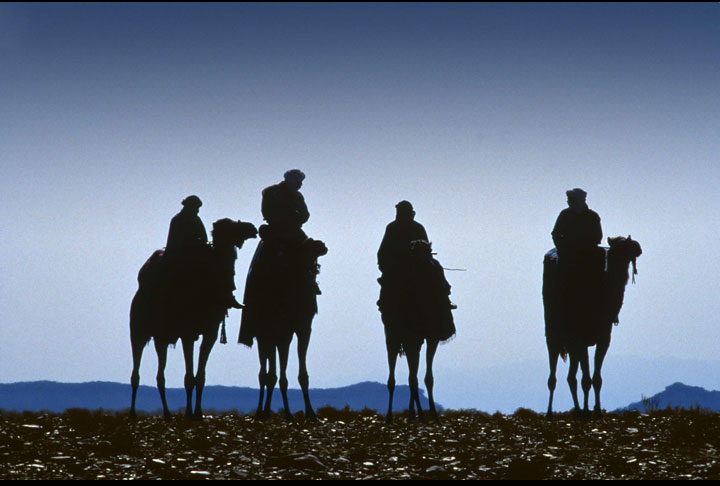
The Betacam was on the tripod, locked off and shooting directly into the sun. The idea was for five Tuareg riders on their camels to circle the camera, creating silhouettes against the desert sky. As each Tuareg passed, a burst of sunlight would splash, striking the lens, hopefully creating great B-roll. At least, that was the plan.

As I started to set up the shot, and without warning, I was subjected to a forceful whack to the back of my head. As I lay semi-conscious, face down on the hot, sun-baked ground – and with the legs of the tripod entangled in my lower limbs – I heard a loud, gassy belch.

The attack was not by some crazed Jihad but a long-necked, long-legged, wooly dromedary with a Chris Brown attitude. The twenty-seven pound camera teetered on my back and shoulder, the lens resting on my head. Interrupting the faint sound of the camera’s internal recording heads rolling was another belch: a loud, guttural siren accompanied by a violent, sputtering snort. Fumes of rotten vegetables contaminated the otherwise unsullied air and a cloud of scattered earth fell over my face.

The heat from the desert floor forced its way through my clothes, searing my torso and palms like a steak. I opened my eyes to a vertical world and immediately recognized the image inches away from my face: a hairy camel hoof with two protruding toenails on a broad pad about the size of a dinner plate.

I then became aware that fluid was trickling down my forehead, behind my right ear and towards my neck. ‘Oh, God,’ I thought, ‘I’m bleeding!’

Still disoriented, the sensation that the back of my scalp was soaking wet and that my shirt was firmly plastered to my back made me reach for the nape of my neck. I just hoped my hand wouldn’t come back red. I quickly deduced that I wasn’t horrifically bleeding. Why was I so wet? Jesus, did I urinate on myself? If so, how did it get up here? Pawing at my neck, it came to me why I was drenched in such foul-smelling gunk.

There are two myths about camels spitting. Firstly, camels do not spit habitually, they only spit when provoked. Secondly, camels do not ‘spit’ saliva but the partially digested contents from the chambers of their fore-stomachs.

When camels are angry or threatened, they ‘burp up’ some of their cud. Once the cud is in their mouths they angrily wield their heads like mad birds. The cud is propelled from their mouth onto their droopy lips, which they fling in the direction of their victim, which, in this case, was me. The amount of camel spittle foisted on a victim could cover their upper torso, and the color is tied to their dietary intake. It appeared that this camel had been eating dates, grass or wheat, as I was covered in a sickly, tea-green colored ‘smoothie’, not that it looked appetizing or nutritious sliding off my skin.

The camel’s slobber was sticky and thick, like cheap hair gel. With helping hands and laughter from the Tuareg, the tripod and my legs were divorced without damage to the camera or the lens, though I couldn’t say the same for my ego. I turned the camera off (it had been in recording mode, capturing the attack in all its disgusting detail), making a mental note to review the footage later in the day.

The laughter and pointing of fingers continued as I dusted myself off and tried to regain some composure. Turned out my baseball cap had been knocked off during the camel’s SmackDown, and as I looked at my reflection in the lens of the camera, I could see that my face had been powdered with beige earth. A huge cow-lick of hair came straight up from the back of my head – sort of a backwards Donald Trump coiffure.

With my breath and a soft brush, I swept sand and grime from the exterior of the camera, using my toothbrush to clean the nooks and crannies around the lens. Fortunately, there was no camel drool on the equipment.

Still unaware of what had pissed the camel off, I moved more cautiously and drafted Abdul to stand sentry behind me. Abdul didn’t want to be there either, but since his name means ‘Servant of the Peaceful One’ he had no choice. Without further incident I got the pretty silhouette shot I was going for.

Before leaving the location, I played back the tape to check that: a) it had recorded, and b) that there was no break up or other problems with the image. I then gestured to each Tuareg to look through the viewfinder at what we’d shot. Regardless of their image, the Tuareg had all their teeth, something I noted when kindly rewarded with smiles of approval at the footage.

We wouldn’t be able to come back and reshoot the sequence which, I think, after departing any location is the worst phone call a shooter can get. Such instruction is usually from the editor or executive producer, saying the footage is damaged, unusable, or a combination of the two. It’s often referred to by a technical term: ‘Shit!’

This has happened to me on a couple of occasions; each time I felt the blood draining from my veins and my self-esteem turn to liquid. It takes weeks to recover from ‘the call’. As a result, you learn to be militant when cleaning the camera gear and checking the tapes. There’s a tremendous amount of pressure to deliver sparkling footage that is in focus and not overexposed nor underexposed, which has no swish pans or tilts, and with just the right amount of headroom. The terrifying truth is that when you fuck up, people will see your mistake. And, in some cases, when you fuck up, millions will see your mistake. It’s every shooter’s fear.

We take every precaution, including hand-carrying the camera and footage onto flights, using leaded bags and DHL delivery. Our reputation – the only marketing tool we have – is based on what we deliver. As we often say: ‘You’re only as good as your last shot’.

With the Land Cruiser loaded, I sat in the cab. I grabbed the Snoopy air freshener from the rear-view mirror and deeply inhaled, hoping for a little relief from the stench of my sweat mixed with camel smoothie. My shirt, now dry, was grafted to my back and needed peeling from me like dead, sunburned skin. With the windows down, we headed back to our base to wash off the stains of the day.

My practice, while on location, is to have two changes of work shirts and trousers. When I’m back at base, I stand in the shower with all my clothes on, lather-up with a bar of soap and scrub them clean. This is an old practice that has worked well over the years. After rinsing and wringing, I then hang them on a makeshift clothes-line made of parachute cord, which also makes up part of my kit; come morning, my clothes will always be dry.

My shirts are ExOfficio – they’re as expensive as hell but worth every cent. They’re quick drying, sun-protective and they have great pockets. Cargo pants are Columbia’s convertible trousers; they also dry quickly and (most importantly) they have a gusseted crotch to help facilitate freedom of movement for increased comfort. With regards to my underwear and socks, I just estimate how many weeks I’m gone and simply toss away the skivvies and socks at the end of each day. Someone once suggested that I should buy ‘Depends for Men’; a very stupid idea: in the desert your ‘boys’ need to breathe, not drown.

On one occasion I’d underestimated my stay on a shoot in the Sahara and was forced to turn my underwear and socks inside out for over a week. With no stores in sight and as cotton takes forever to dry it was easier to toss aside and go commando. What a mistake! I suffered horrific chafing and the worst heat rash I’ve ever had. Both my inner thighs were rubbed red-raw along with my testicles: for three weeks I had to continually apply medicated cream to my infected crotch before the rash cleared up. I walked as if I had a spiked bowling ball between my legs. It was a very painful lesson to learn.

After a hot shower – a definite rarity – we went for dinner. The meal consisted of (stringy) chicken shawarma pitas and my favorite food: fried falafel dipped in hummus, washed down with warm orange Fanta. Our schedules, jam-packed with driving to locations, shooting interviews and gathering B-roll, afforded little time to eat; once we leave the plane, we hit the ground running, existing only on Balance bars, Coca-Cola and espressos.

We ate dessert outside under the Milky Way, which seemed almost within our reach. Little separates heaven and earth in the desert.

It’s customary in the Middle East to socialize in the evening, smoking shisha (apple tobacco from a hookah pipe) and mulling over the day’s events. Sitting in molded plastic patio chairs, we smoked, drank hot tea, and watched an Arab soap opera on a black and white television. One of the antennas was wrapped with aluminum and had been sculpted to look like a rabbit. The TV was connected to a car battery that had been decorated with Hello Kitty stickers. In the distance, breaking the serenity, I heard a camel bellowing. Any more relaxed and I’d have been in a coma.

Before going to bed, I viewed the tapes once more, labeling them with dates and a quick description. I cleaned the gear, charged batteries, made production notes, did some petty cash book-keeping, read the itinerary for the following day, checked the map for locations, and finally set three alarms for 5 a.m. to shoot the sunrise. It was 2 a.m. before I finally got to sleep.

Boots-and-LR-WP 1copy

*****

Assignment: Lost Dinosaurs of Egypt Shoot

Location: approximately mid-way between Dakhla and Bahariya Oasis – Western Egypt

Mark Hufnail, executive producer and long time friend, hired me to shoot ‘The Lost Dinosaurs of Egypt’ documentary. We were deep in Egypt’s interior, beyond Bahariya Oasis, and we’d been shooting non-stop for days. I relished shooting at midday, capturing waves of heat rising from the scorching sand and apparitions of lakes beyond our reach.

I appreciated the power of the sun from the very first time I went to the Sahara. I’d rested my cheek on the side of the camera while looking through the viewfinder; my face burned with such intensity that, for a couple of days, I had a large, red, rosy birthmark on my cheek. From that first experience, I learned to soak my kefflyeh (scarf) with water and wrap it around the camera to keep it cool.

For late afternoon shooting, I picked a location facing west to where the sun was due to set. The stage was a large, symmetrical star sand dune (star dunes are pyramidal mounds with slip-faces, on three or more arms, that radiate from the high center of the mound. They tend to accumulate in areas with multidirectional winds, a supreme annoyance I often have to deal with).

It was to be the last shot of the day and a welcome relief from the desert heat. If all went well, this would be the money shot. I’d planned the scene with two Bedouins in the foreground. As they led their camels across the top of the sand dune they’d appear as silhouettes against the giant orange ball that was the setting sun. I just hoped the camels would prove to be co-operative.

Camels are known as the ‘ships of the desert’; they can travel across desert sands with a speed of up to eight to ten m.p.h. They can maintain this speed for longer periods of time over great distances – about thirty miles a day – even with extremely heavy loads.

With this knowledge, I decided to start shooting three minutes before sunset. Inwardly pleading for all the planets to be in alignment and for a little luck to go my way, I hoped to get one good take of the Bedouins and camels passing in-front of the setting sun.

Houston, we have a problem. As I started recording, the winds picked up. Sand started to blow in all directions, spiraling around me.

‘Holy crap! Not now!’ I muttered.

I was shooting on a long lens with a two-time extender, which meant that any small movement of the camera, no matter how subtle, caused the image to be shaky. Out of fear of getting ‘the call’ and being told that the footage was unusable, too shaky, or too shitty, I went into madman overdrive.

I’d already taken precautions by tightening the tilt and pan head and dropping the legs of the tripod to their lowest point above the ground. I dumped all the contents from my backpack and filled them with camera batteries, my Nikon 35mm camera, bottled water, rocks, sand…anything I could get my hands on that would hold weight. I took the anvil case and tried building a protective wall around the camera. The camera’s shaking stabilized, in spite of the many gusts of wind.

I grabbed the walkie-talkie. I had less then three minutes left to get the shot. I called out, ‘Mark, cue the camels. Mark!’

‘Copy. Cue the camels.’

I had two minutes and twenty-four seconds left before the sun set. The frame was empty, no Bedouins or their camels in sight. With adrenalin in my throat, I barked, ‘I don’t see them! I don’t see the camels. Cue the camels! The sun is setting!’

There was a pause. Then Mark replied, ‘They’re going…and they’re going!’

Looking in the viewfinder I saw the first Bedouin enter the frame. Jesus! It was such a relief to see them. ’Okay, there they are… there they are… keep them going… keep them going. Good, good.’

Two minutes and twelve seconds until sunset.

A gust of wind blew hard against the camera and my face was spiked with sand pellets. As the last Bedouin and his camel exited the frame, I had one minute and fifty-six seconds left before the sun went to bed.

I needed them to turn around and cross the frame again. Straining not to overreact, I grabbed the walkie-talkie. ‘Mark, turn them around. Turn them around! Hurry, hurry…turn them around. Turn the camels around!’

‘Okay, we’re turning them, we’re turning them. Stand by…’

I could see the sun accelerating in its fall. One minute and forty seconds of light left. Now I was pleading: ‘Hurry! Hit them in the ass or something!’

‘We’re hurrying! Camels don’t turn on a dime, Dave, we’re hurrying!’

The first camel had its tail up. ‘That camel better not take a crap,’ I warned.

Mark, very calmly, replied: ‘Nothing I can do about that, Dave, sorry.’             I held my breath and prayed that the camel didn’t evacuate its bowels. Slowly, the two Bedouins and their camels sauntered across the frame without incident and exited the shot.

‘Dave, Dave, did we get it? Are we done?’

I stopped recording and checked the tape. I’d managed to get three good passes with just a little shaking that could be minimized in post-production. After a deep sigh, I put the walkie-talkie to my mouth.    ‘That’s a wrap,’ I said. I celebrated this small achievement with a little ‘end zone’ dance before sitting down by the legs of the tripod to enjoy the sun’s departure from the day.

My adrenalin had faded and I became aware of a great stillness surrounding me. The Sahara had toyed with me but now, as I sat in the desert, I felt blessed to be there, with only Mother Nature as an audience.

There was a silence. A silence so great, I could actually hear the earth breathing.


Whitewater WestBeirut L.A., Chapter 4, Cue the Camels Book

‘Scenes of rape in the arroyo, seduction in cars, abandoned buildings, fights at the food stand; the dust, the shoes, open shirts and raised collars, bright sculptured hair’

~ Latino Chrome lyrics by Jim Morrison, The Doors

Prologue

On April 29, 1992, twelve jurors in Simi Valley, California, delivered their verdicts in a controversial case involving the 1991 beating of Rodney King by four LAPD officers. The case received international attention when grainy footage of the officers’ attack on King was televised and it became a national scandal. The beating would never have been seen had it not been for George Holliday, who grabbed his video camera and stepped onto his balcony when he was awoken by sirens.

The verdict was read: all four officers were acquitted of excessive force and cleared of all charges. Due to the extensive media coverage, the public received immediate news of the verdict. Reaction in Los Angeles was swift as people began venting their anger. L.A. became a scene from a war movie, albeit one far from the facade of a studio.

The following night I picked up an assignment for CBS news to cover film director Spike Lee’s speaking engagement at the University of California in Irvine. The timing was ironic; following the King beating and the LAPD officers’ verdict, it was day two of the rioting. Spike was to talk about his new film ‘Malcolm X’. Irvine is about 45 miles south of Los Angeles, in the county famed for its oranges. Spike never made it; the announcement was made in the UC auditorium that, as a result of an upsurge in violence in L.A. and due to an exodus of traffic causing congestion on the freeways, Mr. Lee was unable to attend his engagement.

I’d taken the precaution of renting an Oldsmobile Cutlass Ciera; my 1978 Volkswagen Bus just didn’t have the speed or the protection for riding around the city of Los Angeles under such challenging circumstances and against brutal violence.

I packed up the camera and rushed back to L.A., heading north on the 405 freeway. It had been closed and was therefore free of traffic by the time I neared Los Angeles International Airport (LAX). With no police scanner to monitor the situation, I listened to KFWB news radio for leads, following police vehicles, helicopters and fire trucks that may have led me to riot hotspots. From their reports, I deduced that the worst fires and looting were taking place in central Los Angeles. At the interchange I took the on-ramp to the Santa Monica freeway that sits high above the ground on concrete columns. This gave me a spectacular view of L.A.’s cityscape – it stretched out before me, hundreds of dark gray smoky plumes spiraling upwards to meet the black sky. I could smell the distinctive stench of burning asphalt shingles, wood and rubber. Jesus! It’s Beirut L.A.

Lingering in the night, like a string of Christmas tree lights, were several police and news helicopters, their distinctive red and green pulsing taillights circling where civil unrest seemed to be worst. Known on the streets as Ghetto Birds, the LAPD helicopters sliced the darkness with their powerful searchlights on fixed points of unrestrained violence as media helicopters converged, scavenging on the carcass of a ravaged city. Above the helicopters were processions of commercial airliners with white lights making their final approach to land at LAX; the passengers looking down below were witnesses to a city gone mad.

Speeding along at 144 k.p.h, towards central L.A., I passed a huge house fire. ‘There’s a man on that roof!’ I shouted to anyone listening. I braked, leaving skid-marks and burnt rubber on the freeway, shifted into reverse and backed up to a suitable point to evaluate the scene. The silhouette of a man with a garden hose looked cartoonish against a wall of yellowy-orange flames. The sound of wood beams splitting from the heat of the fire rang in my ears. I grabbed my camera and rolled the tape, capturing the man as he moved back and forth, dousing the roof with water. I was eighty feet away, but I could still feel the heat as the building cooked.

Mesmerized by what looked like a wasted effort on the man’s part, his hose spraying out little attack towards the ferocity of the fire, I was unnerved by the sound of something whizzing past my ear. I heard the air split wide open as the hissing of a bullet passed by, followed by the sharp cracks of gunshots. I reacted automatically, panning the camera over to where the sounds were originating from when another shot was fired. Shouting began and a car peeled out onto the street below me.  I had no idea if I was the target but I managed to get it on tape. I continued shooting film throughout the night, and it was only when I was filming a mass arrest of looters at a Von grocery store that a voice from behind me reminded me of my vulnerability.

‘You better watch out, cameraman.’

I paused. I didn’t want to press my luck so I packed up and drove to CBS Television City in the Fairfax District and licensed my footage to CBS news. The Oldsmobile, I returned without any damage.

April 30, 1992: President George W. Bush announced that he’d ordered the Department of Justice to investigate the possibility of filing charges against the LAPD officers, for violating the federal civil rights of Rodney King.

August 4, 1992: A federal grand jury returned indictments against Sergeant Stacey Koon and Officer Laurence Powell, both guilty of violating Rodney King’s constitutional rights, with an additional count against Sergeant Koon of willfully permitting the other officers to beat King.

Nearly six months later, on February 25 1993, the trial began in the courtroom of Judge Davies, on the charge of violating the civil rights of Rodney King.

April Fools Day, 1993: Expecting that history would most likely repeat itself, all local, national and international news outlets were gearing up to cover L.A.’s reaction to the verdict. I had been inundated by phone calls from news organizations to cover the event from the end of March. The booking I took was with the A.D. Production Company, the producers of the American Detective show that aired on ABC Network. I was on and off the phone throughout the morning with Mark, who’d produced the riot segment for American Detective.

‘Dave? This is Mark. We’re expecting a verdict soon on the King beating. If the cops are found not guilty there’ll be another riot. If they’re found guilty there may still be a riot. What’s your standby rate if a riot doesn’t happen right away? And do you have a gyro-zoom lens for the helicopter shots?’

Even though we’ve worked together for years, the business of booking has to be clear with very little negotiation; it is pay or play. For my services and for my camera, lighting package and audio gear, it runs to seven hundred dollars a day.

‘Well, Mark,’ I explained, ‘I’ll hold off until another job comes down. There’s no standby rate on my camera package, and yes, I have a gyro-zoom lens.”

There was a pause from Mark. I could hear talking in the background; I must have been on speakerphone.

Mark returned to our conversation. ‘Okay, okay. You’ll be positioned in the Special Enforcement Bureau command center of the Los Angeles Sheriff’s Department, in south-central L.A. You’ve also been given clearance to ride along in their helicopter.’

In my experience, I’ve always found it best not to get too excited about a standby gig, since most inevitably go away on the same day the production companies hire you. This led to the question: ‘Do you want me to ink the date in my diary or shall I use pencil?’

Mark replied, ‘Pencil. By the way, we’ve also hired you a bodyguard for if we reassign you to the streets. If that’s the case, your bodyguard is on the SWAT team of the San Jose Police Department. Oh, and do you have a sun gun light for your camera?’ Mark asked.

Taking notes, I replied, ‘It’s been my experience that a light on a camera makes for a good target.’

‘Oh, good thinking. Okay, we’ll see you on the 12th of April, Monday morning, at the Wyndham Garden Hotel in Commerce. We’ll also rent a bulletproof car, if we reassign you.’

‘How much is that going to cost you?’ I said.

‘A thousand dollars a day.’

I wasn’t surprised – you can rent anything in Hollywood. I called Bexel, the largest vendor of broadcast equipment in the country, to sublease some extra wireless microphones, a gyro-zoom lens and a wide-angle adaptor. I got hold of my friend, John Badovinac, who handled my rental account. ‘JB, this is Dave. Do you have…’ Before I could finish my sentence, John interrupted me.

‘Sorry, Dave, CBS has ten cameras and two gyro-zoom lenses and ABC has just rented what was left on the shelves.’

‘What? This is crazy. This is really crazy!’

‘We’ve rented out everything that has a lens. The networks and local stations are treating this trial as if it was the ‘84 Olympics.’

April 16, 1993: The federal jury convicted Koon and Powell on one charge of violating King’s civil rights. Sergeant Koon and Officer Powell received two and half years in prison. Officer Tony Briseno and Timothy Wind were found not guilty.

April 17, 1993: It was Saturday, 2:30 a.m. I was fully clothed and laid in bed, watching the re-edited version of Dune on television. I munched on another peanut butter Girl Scout cookie and sipped black coffee that was loaded with tons of sugar. I was in a hotel room at the Wyndham Garden Hotel, along with off-duty San Jose detectives and one ex-navy Seal, all of whom had been hired and assigned to me as bodyguards. They were armed to the teeth; the Seal was to drive our rented bulletproof Crown Victoria. Our team had been issued with flak jackets, Kevlar helmets, pepper spray and Israeli gas masks. Ironically, the instructions for the gas masks were in Hebrew which none of us could read.

Though I wasn’t upfront and close to the L.A. riots of 1992, I now had an official backstage pass to the ‘L.A Riots -1993 Tour’.

The decision was made to embed me within the Special Enforcements Bureau instead of a helicopter, in a platoon made up of thirty-six deputy sheriffs. We were to travel in sixteen marked patrol cars and one armored hostage rescue vehicle.

3:15 a.m.: The call came in to prep the gear, check out and travel to a new location. Dammit! Dune isn’t over and I’m going to miss the best part – where the giant sandworms appear to destroy the Harvesters mining on planet Arrakis!

In the hotel lobby I was informed that the production company had had second thoughts; they felt that the thousand-dollar-a-day bulletproof car was too expensive. They didn’t want to be held responsible for any ‘unnecessary’ damage. It looked like I was going to be riding in a deputy sheriff’s patrol car.

8:25 a.m.: We rendezvoused with several other platoons made up of uniformed deputies, in what appeared to be an abandoned hotel parking lot. I looked around the place: I saw some of the deputies relaxing in their vehicles while others paced outside nervously. No one was going to tell me how to behave or exactly what to expect. It was at that moment, as I distracted myself from such thoughts with a fruitless search for coffee, that I heard the verdict and sentencing of the defendants in the second Rodney King trial.

Several of the patrol cars had their trunks open with portable radios tuned to the KFWB news radio. The newscaster’s flat voice echoed across the parking lot, along with news of the war in Bosnia and Herzegovina, a nuclear accident in Russia, a fire-fight with the Branch Davidians in Waco, Texas, and a nifty review of Billy Crystal’s hosting of the 65th Academy Awards.

9:20 a.m.: The platoon relocated to a substation at the City Hall Complex in Lynwood.

11:25 a.m.: This was our first sit-down meal in two days. I was sitting in a plastic molded chair and table that had both been bolted to the floor. This was Angelo’s Burgers, a small fast-food joint at the corner of Imperial Highway and Atlantic Boulevard in Lynwood, California. As I ate my breakfast bean burrito and drank my second cup of coffee, I notice a handmade cardboard sign that had been written on with a magic marker resting on the counter where you placed your order. ‘Falling Down, with Michael Douglas, was filmed here on May 12th, 1992.’

It was at Angelo’s that Michael Douglas’ beleaguered character terrorized a fast-food chain called ‘Whammy Burgers’. I remembered his almost understandable motive for going berserk – the menu had progressed to lunch, and all he wanted was a little breakfast. In short, the movie was about a man in L.A. who went bonkers, so it was ironic that we were in Angelo’s with deputy sheriffs, having breakfast, whilst waiting for a city to go bonkers.


2:15 p.m.: Despite the announcement of the court’s verdict, this wasn’t what saw us race, at top speed, from Lynwood to an amusement park north of Los Angeles. A thousand tickets had oversold at a scheduled rap concert. Not surprisingly, some of the fans were upset and, out of frustration, had shattered the windows of restaurants across the street from the amusement park’s entrance.

4:35 p.m.: Boredom started to kick in. The deputies, our crew and assorted bodyguards were in a holding pattern at the upper entrance to the park. Everyone was hungry. With my supply of Balance bars and gum gone, all I had left was a bag full of Atomic Fireball jawbreakers, which I promptly started to throw at the deputies and production crew, shouting, ‘I’m coming!’

The production company eventually decided to get McDonald’s quarter-pounders for everyone. Halfway through the order, McDonald’s ran out of burgers, so most of the crew and the seventy-plus deputies ended up with Happy Meals. The Happy Meals came in red cartons and inside each was a toy action figure from Batman. A trade-off began between Batman, the Joker and Two Face, though it was Catwoman in her fitted gray costume that proved to be the most coveted.

7:46 p.m.: The sun set. I grabbed the Betacam and my Nikon camera and tagged along with a squad of seven deputies. We took in the sights and sounds of the park and I wondered to myself if we were going to stop long enough to get a corn dog.  Occasionally, families and kids, looking for a way out of the park, stopped us and asked for directions. No one in our group was familiar enough with the park so we weren’t much help.

We’d not been in the park longer than fifteen or twenty minutes when there was a distinct change in the atmosphere. Instinctively, I hoisted the Betacam on my shoulder and removed the lens cap from my Nikon.

There was a lull in the night’s sounds. The normal carnival atmosphere had diminished; where laughter and the excited screams of kids on wild rides had filled the air just minutes ago, there was now just a low hum and relative silence. Something was happening. All of a sudden, there was a new sound – a differently pitched scream travelling through the air. It was a disconcerted screech that built in intensity, continuing until all the laughter had been swallowed. A swelling of emotion rose from my stomach, settling into my chest and heart.

Time seemed to shift then split, both streams working simultaneously. Different scenarios presented themselves in slow motion, while craziness was kicking off in the background in ‘quick time’. I was rolling tape and filming with the camera on my right shoulder while shooting stills using my left hand.

Like locusts swarming upon a field of grain, kids and families poured out of nowhere and surrounded us. The deputies reacted quickly, creating a circle in the middle of a concrete walkway. If you’d have looked down from overhead, you would’ve seen a circle of tan helmets surrounded by a sea of bodies with a sergeant in the middle trying to hear the two-way radio above the noise. One of my eyes was glued to the Nikon’s viewfinder when the camera’s motor drive whined with a ‘click-click-click-click-click’. Framed faces held expressions of dread, concern and confusion as the volume of pandemonium rose to an even higher decibel.

Somewhere in the park ahead of us panic struck like a flash of lightning. We caught the first swell of people seeking safety: a stampede of hundreds barreled right at us. What the crowd needed was a concrete wall, five-feet thick; we were but a mere fence of eight people. The crying, shouting and screaming escalated again. In the distance, ‘snaps’ could be heard. More screams from the stampede.

A deputy shouted, ‘Was that gunfire? WAS THAT GUNFIRE?!’

The mob receded a little, confusion filling the void. The milling crowd looked set to disperse; again, gunshots or firecrackers were heard somewhere in the park. A tidal wave of families, in sheer panic, descended upon us.

Unlike the 1992 riots, what was happening had an element of vulnerability from the families caught in the middle of a total breakdown of civil order. A group of teenage boys and girls ran up to us, screaming that one of the park’s security guys was getting beaten up behind us. We turned but couldn’t see anything other than a wall of bodies a hundred yards deep.

More deputies arrived from nowhere and we made our way across a sea of glass shards, white plastic coat hangers, price tags and paper images of cartoon characters. I filmed the sheriff’s helicopter as it flew overhead, its powerful spotlight shining down on the confused throng, creating massive shadows from the tree limbs and scaffolding which slowly crawled over the entire area like a black web. Looking through the black and white viewfinder the shadow looked ominous – almost alive.

As we passed a restaurant, I noticed that the doors were cracked. I stopped to peer into the darkness. In the foreground were the legs of chairs, tables and serving trays stacked on top of each other. Beyond the barrier a young man, dressed in his chef’s hat and whites, stared at me with a dazed, anxious look. I rested the Betacam on the ground and wedged my Nikon lens between the doors, snapping off a couple of shots. I could only assume that he’d chosen to stand sentry, protecting his co-workers and guests with a fire extinguisher as the world beyond the restaurant door suffered a momentary lapse of sanity.

The park was now quieter as the deputies prodded the visitors, containing them in the main entrance. I passed a long line of kids at a pay phone trying to call their parents to come and get them. Nearby, I saw a marble statue of a rabbit on horseback waving goodbye to its guests.

April 19, 1993: I read that morning in the L.A. Times that the park reopened on Sunday to an enthusiastic spring break crowd as law enforcement officials, park managers and a music promoter tried to pinpoint blame for the melee that damaged both the park and its reputation as a place for family entertainment. An all-night repair job replaced broken windows and a restock of looted merchandise was completed in time for Sunday’s 10 a.m. opening.

I later learned that the ‘confused mass of people’ cost the park an estimated two million dollars in damages. Forty people were evacuated as an emergency, and it took 450 deputies to move 40,000 people out of the park.

Urban legend has it that a body was found underneath the Viper rollercoaster ride four days after the riot.

During the comedown, in showbiz news, there was a big buzz around the release of Steven Spielberg’s film, Jurassic Park, about a team of genetic engineers who created an amusement park full of cloned dinosaurs before all hell broke out. Sometimes, science fiction can be a little too realistic.

Within days I picked up an assignment to the Middle East. As sad as it sounds, I was well prepared.

Epilogue

June 17, 2012: Rodney King, the man at the center of the infamous Los Angeles riots, was found dead in his home in San Bernardino, California. He was forty-seven. According to media reports, King’s fiancée, Cynthia Kelly, found him dead at the bottom of a swimming pool. King recently marked the twentieth anniversary of the riots. Mr. King, whose life was a roller coaster of drug and alcohol abuse, multiple arrests and unwanted celebrity, pleaded for calm during the 1992 riots, in which more than 55 people were killed, 600 buildings were destroyed and the city suffered $1 billion dollars worth of damage.

August, 23, 2012: The autopsy findings by the San Bernardino County Sheriff’s Department, Coroner Division: The effects of the drugs and alcohol, combined with the subject’s heart condition, probably precipitated a cardiac arrhythmia, and the subject, thus incapacitated, was unable to save himself and drowned. There’s nothing in the history or autopsy examination to suggest suicide or homicide, and the manner of death is therefore judged to be an accident.

              “People, I just want to say, you know, can we all get along? Can we all get along? Please….we can get along here.”

– Mr. Rodney King, May 1, 1992