 After a day of traveling aimlessly along Sunset Boulevard it was time to take a break. It had been a good day of harvesting cigarette butts. Joe had always felt it was his civic duty to help address this serious environmental problem by picking up this toxic waste. Now was the time to sit and enjoy the fruits of his labor. He watched for awhile the congestion of traffic and remembered the time he too lived that life…. but no more. The last few embers glowed at the end of the cigarette as Joe inhaled, and as the white smoke curled up in a spiral motion, he pressed lightly his shirt pocket to the fragment ends of tobacco to insure a reserve till morning. Taking the last drag the ashes glowed brighter and crackled as air passed through the cigarette and the smoke went deeply into his lungs. He dropped the butt on the concrete and stubbed it out in a rhythmical tapping of his right foot. How wonderful it would have been to have a cup of coffee to accompanied his cigarette break he thought. The sun had set, but he had decided to stay sitting on the bench and watch the world drive by and maybe have another cigarette.
Category: cigarette break
Cue The Camels: Rucksack Essentials: La Musica
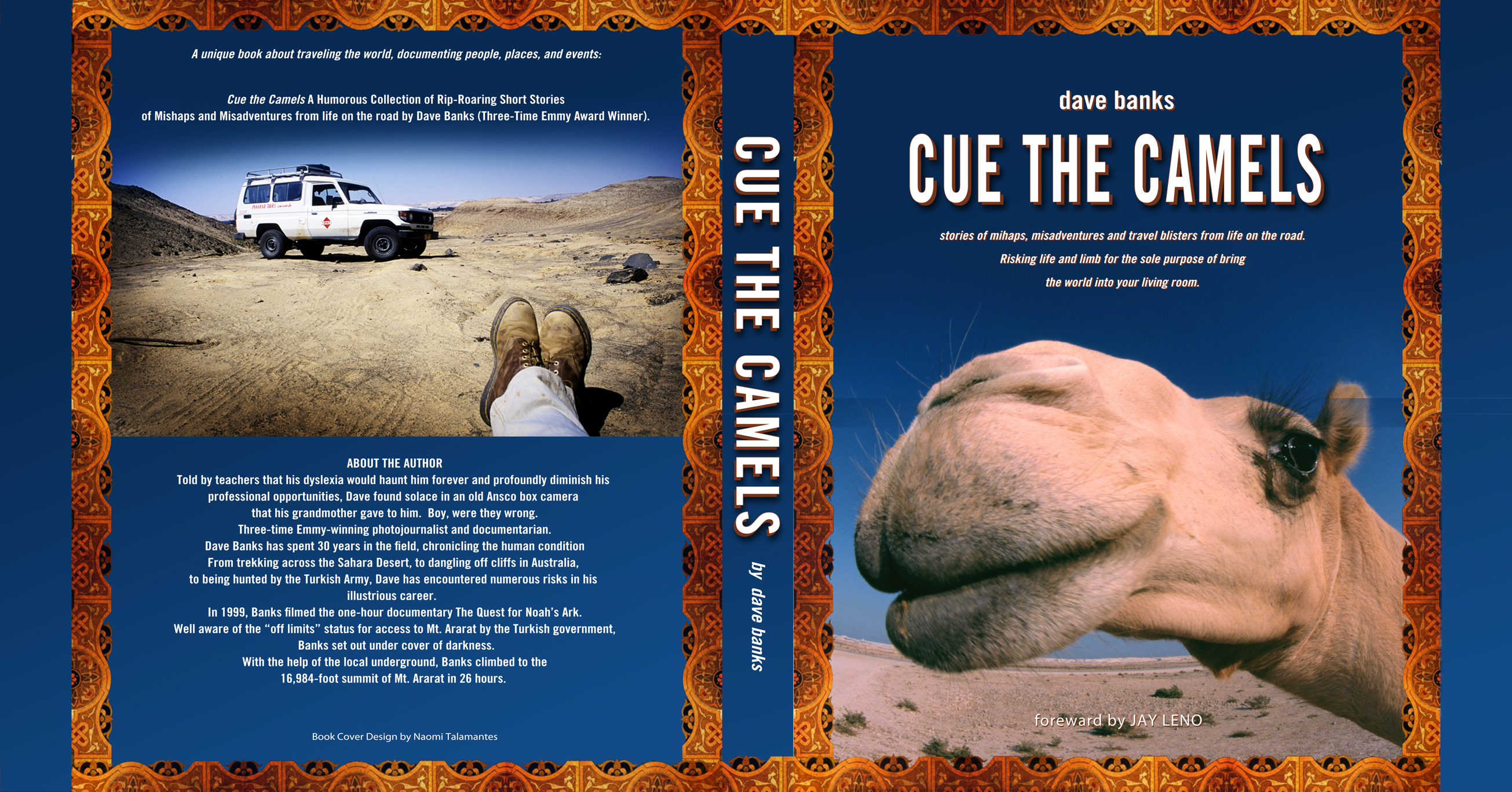
Chapter Six
Music is a safe kind of high – Jimi Hendrix
It’s not that I’m a snob about music but any world traveler will tell you that one of the most essential items in your rucksack is your music. My choice of tunes has become the soundtrack for many of my journeys, often saving my sanity. I can attest that there is nothing better then listening to your iPod on a transatlantic flight, it evokes a wonderful state of being that takes you away from the crying babies and exasperated mothers. Music has protected me from exasperation when Egyptian wedding parties have still been going strong at two o’clock in the morning, as well as helping me pass days (not hours) while once waiting for a flight out of Kabul.
For me, Justin Bieber’s mindless pop just doesn’t lend itself to the experience of tearing across sun-bleached sands in the Sahara desert in a Toyota Land Cruiser. The Clash’s ‘Rock the Casbah’, however, does a terrific job and always sets the mood. I have collected CDs from souks, bazaars, back alley kiosks and hotel lobbies; I’d like to think that, as a result, my taste in music is eclectic. You’ll find Middle Eastern dance, Bollywood, Japanese pop, electronica, soul, rock, tango and Neapolitan ballads on my iPod.

Like a still image, a song can transport you back to a moment in time that has been forgotten: a cognitive process that scientists have tried to understand for a long time. For instance, during the wild fires of southern California in 2009 I had a very real flashback when Shakira’s song ‘Whenever, Wherever’ blared out from the radio while I was driving along the Glendale freeway. Combined with the sight of the burning hillside, the fumes of diesel and the ‘thump, thump, thumping’ of the helicopters overhead I was immediately transported back to the Bagram airbase in Afghanistan.
I see music as a synthetic acid that enhances flashbacks of our memories. Scans of the brain have shown that when people listen to music, virtually every neuron becomes more active, which may explain how I’ve overcome a learning disability, dyslexia and attention deficit disorder. Music forces me to focus, which keeps my ADD at bay. Growing up, my parents could never understand why I would play music when reading or studying; they’d just shout at me to turn the record player or radio off.
Once I sit down and play my music I fall into a Zen-like state; my brain slows down to a crawl so that I can concentrate. If it were not for music I would probably be selling used furniture in Tulsa, Oklahoma.
In all societies – with the exception of just one, that I know of: the Taliban – music’s primary function is collective and communal, to bring and bind people together through singing and dancing, should their culture allow. Humans have been making music since those first cavemen’s campfires.
In Kabul, Afghanistan, I spent an afternoon eating lunch that had been cooked on the sidewalk, in front of a carpet store on Chicken Street. The owner and his son stayed and had lunch with me so that they could practice their English. When Kabul was under Taliban control, paper bags, white socks, kite-flying and music were forbidden. This was serious oppression; for instance, possession of a paper bag constituted the death penalty. If they viewed that so severely, imagine what they’d have done if a flash mob broke out to Survivor’s ‘Eye of the Tiger’ – the Taliban would have nuked all of Chicken Street.

To celebrate my host’s and his son’s newfound freedom we played ‘Jump Around’ by House of Pain on his chrome-trimmed ghetto blaster that he’d kept hidden from the Taliban. It must have been very amusing for the ISAF (International Security Assistance Force) troops to see a couple of Afghans and one big white guy jumping to the beat of the music in front of the old carpet store. To this day, when I hear ‘Jump Around’ I can smell the pilaf cooking, feel the heat of the day and, in my mind’s eye, see the physical expression of freedom on the owner’s face and that of his son’s, as they danced with sheer joy.
Prior to a shoot in Egypt I listened to singer Amr Diab which gave me some insight into modern Egyptians’ taste and a clever way to win over friends. I phonetically learned Amr Diab’s hit ‘Nour El Ain – Habiby’. Arabic was not a language I grasped quickly; I know a few phrases like ‘tiizak hamra’: ‘Your ass is red’ (i.e. like a monkey’s); or ‘moxxu gazma’: ‘His mind is (as low and dirty as) a shoe’, a bitter insult. Still, I persevered and mimicked ‘Habiby’ before leaving the States.
Once we landed in Cairo we immediately started shooting. On a production like that there’s not much time to build a friendly relationship with your Egyptian fixer, crew members or driver. Despite the language barrier, we were all very courteous to each other and worked together really well. On day four of the assignment, we were travelling from Cairo to Giza by van; Abubak, our driver, pulled a cassette tape from a black box that he was very protective of, because it contained his personal collection of music. I was in the back of the van as the Egyptian crew sat up front, smoking Cleopatra cigarettes. The intro began to ring out and I felt butterflies in my stomach. Amr Diab sang the first lyric. I stood-up (as much as I could in the van) and belted out, ‘Habibi ya nour el-ain, ya sakin khayali, a’ashek bakali sneen wala ghayrak bibali (translation: My darling, you are the glow in my eyes, you live in my imagination, I adored you for years, no one else is in my mind). I then sang the chorus: ‘Habibi, Habibi, Habibi ya nour el-ain’ (My darling, my darling, my darling glow in my eyes).
I swear to God, one of the crew member’s cigarette dropped out of his mouth, and I could also see in the rear view mirror Abubak’s eyes widen – he nearly rear-ended the Cairo taxi in front. There was a moment of shocked silence – this big white guy from California was singing one of their most popular songs. They began to clap in unison to the beat of the song; one by one they stood up and held their hands high, swaying their hips, as we all sang ‘Habibi, Habibi’. The remaining seven days of our shoot were flawless. Every evening we came together and smoked shisha, played dominos and learned curse words in each other’s language. At the end of the shoot, and before checking in for the flight back to the States, we all stood in the Cairo International Airport parking lot to say our goodbyes and so I could pass out their payment and traditional bonuses. I noticed Abubak walk from the cab of his van with something wrapped in newspaper. He presented me with a gift: my very own hookah and shisha. Surrounded by the Egyptian crew, tears filled my eyes as I accepted their gracious offering. We’d become as close as brothers through our common love of music. As we said our goodbyes I couldn’t hold it in any longer and I openly sobbed as I hugged each of the big, burly, bearded men. They, too, began to weep as I walked away and boarded my flight.
I missed out on securing a bulkhead seat in coach and found myself wedged in a middle seat at the back of the plane. The seat had only enough space for a tiny derriere, which I don’t have – I swear, my toilet seat back home in Burbank was bigger. My legs were cramped up against the gray folding tray hanging from the seat in-front of me that refused to stay up, which seems to happen on every overseas flight I take. I should file a report to Amnesty International that United Airlines commits acts of torture by kneecapping captive consumers.
The in-flight movie was one I’d seen before: a chick movie, ‘Sleepless in Seattle’. It was time to escape into my world. I settled myself as much as I could by placing a pillow between my knees and the seat in-front of me. With my earplugs in and my iPod tuned to my favorite artist, Natacha Atlas, I opened a dog-eared page of my book: The Teachings of Don Juan, by Carlos Castaneda. Having lived in the Sonoran desert of the American southwest, and after working in the Sahara desert, I have an affinity with space, sand and time. As an anthropologist, Castaneda wrote that Don Juan Matus, a Yaqui Indian and shaman, was an expert in the cultivation and use of various psychotropic plants, (specifically, magic mushrooms, angel’s trumpet and peyote) all found in the Mexican deserts. While under their influence, Castaneda reached a transcendental state. At cruising altitude, with the monotone whine of the jet engines and the murmurs of fellow passengers, Natacha’s song, ‘Ya Weledy (My Child)’ began and I hoped to gain similar escapism. The music then turned to an Arab symphony; in my mind a curtain rose and I played back the last few days with my Egyptian friends as Natacha sung: ‘Don’t forget your friends, don’t forget your friends. And those who think of you, and those who think of you, you don’t know what is in front of you. Don’t stray from the path.’
My own hypnotic drug – my music – was starting to kick in and I felt serenity, wedged inside my seat miles from the ground, incarcerated in a metal box. The track changed to Anthony Newley’s ‘What kind of fool am I?’ and I had a vivid flashback of my friend, Ya’akov, whom I worked with in Israel as we searched for a money shot….
*****
The passenger window next to me was tinted yellow from years of exposure to cigarette smoke. Running down the middle of the window was a vertical crack in the shape of lightning; it was stuck halfway which allowed a blast of hot air to penetrate the cab, bringing with it familiar smells of diesel and earth. As the terrain charged by, I idly wondered which biblical figures had walked this ground, and which battles from the Old Testament had been fought there. But it was difficult to ponder such searching questions when my Israeli driver, Ya’akov’s, radio-cassette player screamed ‘What kind of fool am I?’
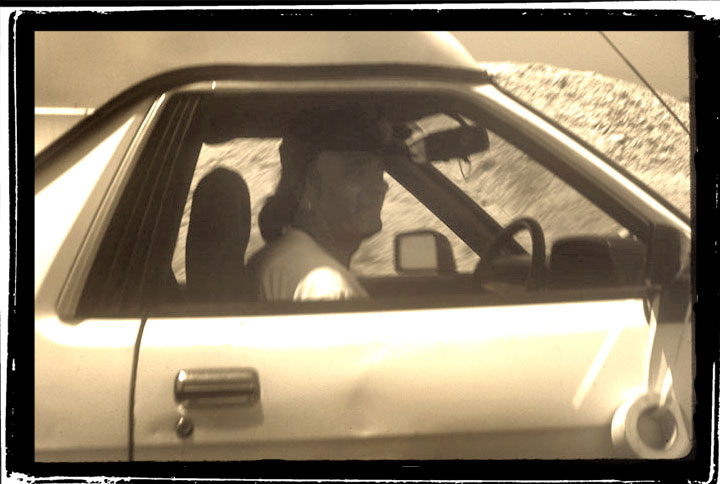
With both hands on the wheel, and an ever-present Marlboro dangling from his lips, Ya’akov belted out the tune, over-enunciating each lyric. A man of small stature, Ya’akov was built like a brick house, with hands like baseball gloves and eyes blue and clear.
For some, pop music is considered to be the demise of civilization but for Ya’akov, it was a blessing. Ya’akov embraced western culture by teaching himself English from the Billboard’s Hot 100 music chart – it was the reason why he strained so hard to pronounce each lyric. Although his accent was definitely Israeli, it switched to a bad Elvis impersonation when he cursed aloud, such as when the undercarriage of his truck scraped the limestone rocks in the road. He also had difficulty with slang, such as when we referred to the ‘walkie talkies’ we used on location. He called them ‘okie dokies’. So used to his description, I still find myself calling them ‘okie dokies’ even now.

Ya’akov relayed his military service history during our trip. He was a veteran of the Six-Day War and witnessed Israel’s history from the front lines. He added that the Beatles released ‘Sgt. Pepper’s Lonely Hearts Club Band’ only days before the battle. He especially liked ‘When I’m 64’.
It was May 1967 when the Egyptian president, Gamal Abdel Nasser, expelled the United Nations’ Emergency Force from the Sinai Peninsula, including the Suez Canal. Egypt subsequently blockaded Israel’s southern ports of Eilat and the Gulf of Aqaba, preventing shipments of Israel’s oil imports. Nasser also had a strategic alliance with Jordan and Syria, with additional military support from Iraq, Saudi Arabia, Sudan, Tunisia, Morocco and Algeria. Egypt had amassed a thousand tanks and nearly a hundred-thousand soldiers on the Israeli border. On June 5, 1967, Israel launched a pre-emptive attack against Egypt. Ariel Sharon commanded the most powerful armored division on the Sinai front, which Ya’akov’s unit was part of. Ya’akov, a machine-gunner, fought in that battle, but not before his unit was held back due to landmines and Egyptian tanks. I can only imagine that while he waited for the orders to move out, Ya’akov was drinking coffee, smoking cigarettes and hoping to make it to 64.
General Sharon broke away from his plan of attack and ordered his troops to follow a camel path through the sand dunes, thus avoiding thousands of landmines and with the intention of surprising the Egyptians. Ya’akov was happy to have just survived the war. He now drove film crews around Israel and sold cartons of Marlboros to the Bedouins.
We were on an old dirt road, somewhere off Highway 79, near Nazareth. Ya’akov maneuvered around bombshell-size potholes; his truck, filled with our camera gear, swayed almost rhythmically to the cassette player. The goal was to find an appropriate filming location in the Israeli outback, one without power lines or any evidence of the twenty-first century. I let my driver – and serendipity – find the money shot.
The first time ‘happy chance’ occurred was when I shot a documentary about the Dead Sea Scrolls. We’d traveled to the cave in Qumran where the scrolls were found by a Bedouin shepherd in 1947. With that segment of the documentary done, and with no further obligations, I put my headphones on and succumbed to Esquivel (which is great travel music). I let fate and inevitability take us down unmarked dirt roads. Hidden away were miles of beautiful, sweeping terrain, perfect for shooting stills and B-roll for the documentary. Since that shoot it has become a ritual to wander aimlessly about our location.
True to this tradition, Ya’akov found a spot and pulled over. He got out a small backpack stove and proceeded to make us coffee. We sat on the back tailgate, smoking cigarettes and stirring our thick, black coffee.
‘Ya’akov,’ I said.
‘Yes, David?’
‘How about another song?’
Without blinking, Ya’akov bellowed, ‘In-a-gadda-da-vida, honey, don’t you know that I love you? In-a-gadda-da-vida, baby, don’t you know that I’ll always be true?’
As he stood in the middle of the old dirt road in the outback of Israel, Ya’akov mimicked playing a Vox organ in D-minor while belting out his tune. ‘Jesus,’ I thought, as I recognized the melody by Iron Butterfly. And then it hit me: the song came out in May of ‘68, right after the dust settled from the Six Day War – around the time Ya’akov started learning English.
As the sun set and Ya’akov rolled out the hits, there was nowhere I would rather have been. I shouted out, ‘Hey, Ya’akov…hand me your okie dokie. I’ll charge it for you.’
Life in the City of Angels: Cigarettes and Relativity
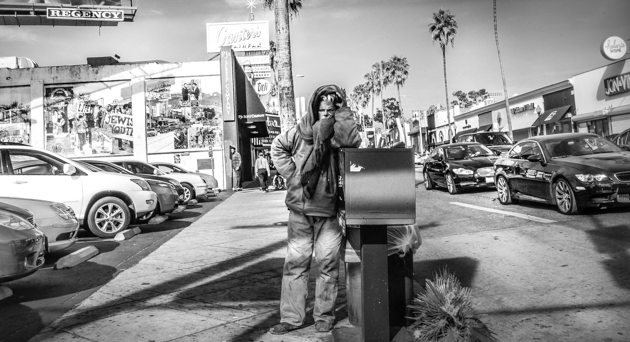 As she rested her elbow on an old L.A. Weekly newspaper bin, she continue to smoke from a stubby discarded cigarette.
She then tells me,
“I have more than once made contact with the pavement and it wasn’t so gingerly either, the last time was at the corner of Fairfax and Beverly.”
“She paused, took the last drag of her cigarette and dropped it on the concrete between her battered boots, strange how the world looks from the ground up, I once saw an ostrich too……. all well…. life has no obligation to give us what we expect.”
Life in the City of Angels: Budslap, Jaw Waggin – An Urban Story.

Witty Metaphorical Monologue Intensifies.
“Jesus you are taking this very seriously bro… It was a joke, stop blithering about an argument we weren’t having over music. Nobody is putting you down, quit being so fragile man. Lets just remain calm and put the thesaurus brain down on the ground nice and easy like.”
“Wow.. Thank you .. you know I played your lists in the car… cheeky stuff… friends always ask .. “what’s that you’re listening to?” glad to oblige .. thanks again for your critique.. I’m a Gimini by the way .. been in bands & played all my life .. for me this is real musician’s music.” ..
“Sounds like some kind of a noir fetish man, where did you find that track at a tobacco shop ?… it’s so slow, listening to this, I couldn’t steady myself with too much scotch in the tank…. way too much smoke in my eyes bro. All I could think about was a pair of soft tits, hard balls and the alabaster stems of the wing feathers.. What is the connection man?..Is it the connections that could keeps you alive or see me dead ? You are more cagier than a Soviet info broker and sharper than a Yakuza blade.”
“Wowww man, I’m shocked with your close minded taste of my music and an attitude of a femme fatal bitch…what did you have for breakfast…a can of dog food? I wouldn’t even be tempted to playing violin at your mothers funeral… for a dollars man.”
“Dont worry man…you will die, just enjoy your music now. By the way – your heart doesnt want to die, it will fight for you and your body to the last microsecond when it will stop. Be grateful for the light that comes through your pupils, one day they will turn grey and you – you will would be gone forever and your stupid music will be forgotten.”
“Hey ! You ready for lunch ?”
“Yeah, I’m hungry, your car or mine ?”
“Where do you want to go….Tally Rand or Los Amigos?”
Life in the City of Angels:Chinwag on Melrose Avenue

“Hey man ! It’s all about infinite reflection isn’t it? We ask for an eternal embrace after our rite of passage, but like string theory it’s always about getting the right vibe. The vibe man, the vibration of energy from someone who believes in the third eye… Jesus! I sound so woo woo or stoned. Which reminds me, back in the day I use to watch wonky Dance Fever on tv while stoned….popping Tootsie Rolls and caramel popcorn, man oh man! Maui Wowie! Good shit back then.
Jesus! Dance Fever man, hosted by that baby face and swarthy Adrian what’s his name of T J Hooker and Captain Kirk. “Where no man has gone before.” Oh yeah, been there in the cerebral abysses man, damn near didn’t come back. Got to go man, have a date at Pink’s Hot Dogs, peace brother.”
 Exposure and Other Worldly Morsels