Written in 2012, “My Affair with Anita Ekberg, Sort Of ” is the most popular read of my blog. For your reading pleasure I extend to you without any significant changes or improvements my own awakening which is whatever young boy experiences when entering puberty.

images-8

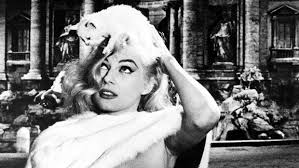
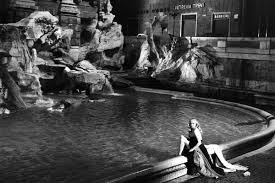
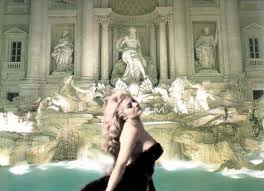
This is the real story of my affair with Anita Ekberg. In 2012, I had written a very short paragraph of my first visit to the Trevi Fountain in Rome, Italy. I recounted how I found a spot away from the gaggle of tourist and for a moment had a short-term detachment from my immediate surroundings to relive the famous scene from Federico Fellini’s film, La Dolce Vita. In my daydream, I replayed the black and white scene of voluptuous Anita Ekberg wading through the fountain as her long blonde hair cascading down her back like the falling water’s behind her. The scene was glorious and lush with sensuality. Anita’s was wearing a strapless black evening gown with its plunging sweetheart neckline and seductively urging Mastroianni to join her in the fountain, 

“Marcello, come here, hurry up!”

All that was missing was Nino Rota’s music when suddenly, I’m back to reality when a tourist with a New Jersey accent asked if I would take a picture of him and his wife in front of the fountain. I was happy to do so, but I remember thinking that I would have loved to stayed little longer in the fantasy corridors of my mind with Anita.

 That’s what I wrote in 2012, but the real backstory is this. It happened one night at the age of thirteen when nature’s process of physical change presented itself while a tourist in slumber land. As I recall, I strolled from scene to scene of Fellini’s movie, La Dolce Vita (The Sweet Life). Unknown-3I’ve always dreamed in color but that night of adolescent awakening, my dream was in black and white and was accompanied with a soundtrack of skewed martini lounge music – which only added to the surreal atmosphere of the celluloid dream. Thinking back, I can only guess that my dream may have been prompted by watching La Dolce Vita on the local PBS station before going to bed. But once in rapid eye movement of deep sleep, I fell from reality to a fantasyland that I can still recall to this day. 

5846The transitions from scene to scene of my dream were preceded with burst of light from the cameras and flashbulbs of the “buzzing insects”, aka paparazzi. I would find myself in the background as a causal observer or a participant in each celluloid episode. Whether strolling among the ruins of Rome or on a luxurious balcony of Rome’s decadent and papered rich high above the City of Seven Hills. With another intense burst of light, I found myself on a Vespa speeding down the narrow lanes of Rome with a twin-lens reflex camera in hand as my fellow insects and I were in hot pursuit of Anita.  images-3

The climax of my dream came as I followed Anita down dimly lite cobbled maze of alleys while a tiny white kitten sat on her head,

“Meow”

“Meow”

“Oh hello”, Anita said turning towards me.

At that moment, my emotions and body began to feel different and quite strange. Here I was with the most unattainable dream woman of my youth, and to top that off, I was being acknowledged of my existence. images-9Before me, Anita wades in the Trevi fountain in her black strapless dress, voluptuous, glamorous, and oozing with sensuality.

“David, come here, hurry up!” Anita’s urging me as she reached out to me

“Hurry up!” she repeated.

Even thought I was lost in my dream, I could feel my heart racing and a fever of heat images-6building up the core of my body. As Anita touched the tips of my fingers, I stepped into the Trevi fountain and instantaneously in a whirlwind of flashing lights; Anita’s lips met mine. – I need not go any further, because it all about biology.

 On January 11, 2015 Anita Ekberg passed away on a Sunday morning in her home near Rome. As most men my age would say, “Forse, quando un sogno diventa una memoria, la memoria diventa un tesoro per la propria vita più dolce. Grazie Anita come bella era, arrivederci e velocità di Dio.”

(Perhaps, when a dream becomes a memory, the memory becomes a treasure to one’s own sweet life. Thank you Anita, how lovely it was, goodbye and God speed.)


Chapter Five

I was in seat number 33E, center aisle, in coach. Brown and yellow stains covered my seat and the tray table hung from a hinge so damaged that I had to prop it up with my left knee. I tried not to make eye contact with a frustrated mother who was stood in the aisle with her crying baby – her submissive husband in standby mode with the baby’s formula bottle in one hand and a clean diaper in the other. The poor man exemplified Henry David Thoreau’s quote: ‘The mass of men lead lives of quiet desperation’. A renegade four-year-old weaved through the cabin and ‘tagged’ an elderly Hasidic man who was praying next to the emergency exit. I just prayed that my iPod wouldn’t die and that the Ambien would soon kick in.

              Our flight from Los Angeles to Tel Aviv was a long sixteen hours. My in-flight entertainment was watching a live performance of Jewish cultural and family dynamics. There was some English spoken on the plane but mostly, a mix of Hebrew and Yiddish filled the stuffy air. The guy on my right was reading The Jewish Daily Forward newspaper and drinking a Sprite. To my left, and fast asleep, was a Teletubby of a man, whose yarmulke had slipped down to his forehead and who, on occasion, snorted like a hog. On my iPod, my Natacha Atlas remix played. Eventually, I entered the ‘twilight zone’ when the Ambien finally took effect.                             

                  As we approached Jerusalem on Highway One from Tel Aviv we could see the city lights reflecting off low-lying clouds. The first time I’d set eyes on Jerusalem was several years previously: it had been a clear night under a full May moon. The limestone walls of the Old City had been awash with blue moonlight and the air had been completely still, and uncomfortably humid. Klezmer music played on the car radio, which seemed appropriate as the streets pulsated with trucks, cars, city buses and pedestrians dodging traffic. Everyone seemed to be in a hurry with their cell phones attached to their ears. 

On this visit, however, there was no moon. Jerusalem was quiet and room service was closed. I lay on the bed munching a Balance bar, stretching my legs and back when the peaceful night vanished with the screech of tires and a ‘Whoosh!’

Below my balcony, on Aharon Katsir Street, a van was on fire. I grabbed my Nikon and got a few shots of the van just as one of the back tires exploded from the heat of the fire. In the distance I could hear sirens as I watched the driver run and disappear into the night.

                  What if the van’s full of explosives and I’ve just watched the driver run away? The Hyatt Regency is full of tourists and here I am, on the balcony, shooting stills – the only thing left of me will be ash, meat and a Nikon F3T!

              But that train of thought wouldn’t lead to the money shot, so I kept shooting until I heard chatter from a walkie-talkie above me, on the roof. 

              Looking up, I could make out the silhouette of an armed guard and the barrel of his Uzi submachine gun. He was dressed like a Ninja, all in black, and wore a balaclava. His conversation was in Hebrew but there was no alarm in the Ninja’s voice. The Israeli fire department arrived, as did the police. They were in the process of putting out the van’s fire when the potential terrorist returned to the scene, showing the police his driver’s license and some papers.       

              When I share this story of the would-be Jihadist and the van on fire, people often ask me, ‘Aren’t you afraid when you go to Israel or the Middle East?’ 

              ‘I’m always very comfortable in Israel,’ I reply. ‘Besides, everyone carries a gun. But what does it say about your faith if you’re afraid to go where Jesus walked?’ Without a beat, I continue, ‘Quite honestly, I’m more fearful of going into a 7-Eleven in L.A. at midnight and getting shot, than I am about getting blown up in the Middle East.’

               The fire of the van had been extinguished so the Israeli fire department left with the police. I watched the driver of the van hail a cab; the show over, I jumped in the shower before falling into a deep sleep. 

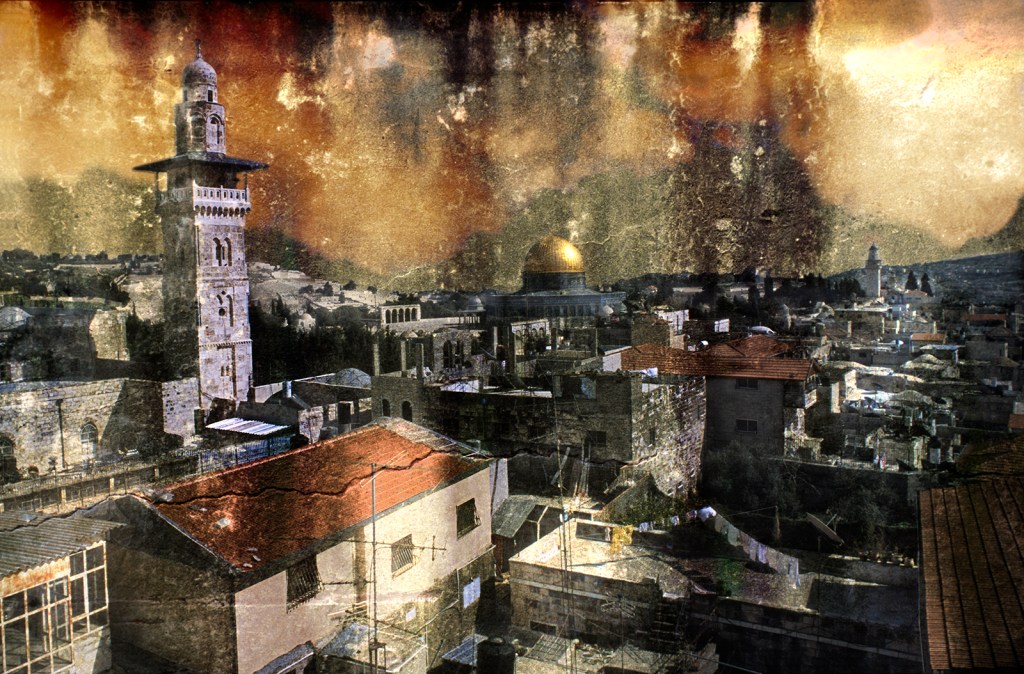
              I woke to the loud chirping of sparrows. The morning sun presented a new day as I walked out onto the balcony to greet it. Below me, the blackened shell of the van sat desolately. I looked beyond its charred skeleton to the Old City of Jerusalem, surrounded by its stone walls and the Damascus and Jaffa Gates. It was hard to imagine that within those walls so much bloodshed had taken place, given that it spanned only 220 acres. Jerusalem, for me, was the Disneyland of the world’s most sacred sites: the Temple Mount, the Western Wall, the Church of the Holy Sepulcher, and the Dome of the Rock. In spite of the many solar panels, satellite dishes and electrical wires cluttering up my eye-line, I could still imagine what the Old City of Jerusalem looked like five hundred years ago.

              Our plan was to start filming at the Christian Quarter’s entrance of the Jaffa Gate, on the west side of the Old City. We would then shoot still images and slices of life throughout the Jewish Quarter before finally moving on to the Muslim Quarter. At that point, we planned to double back and follow the Fourteen Stations of the Cross of the Via Dolorosa, which would lead us to the Church of the Holy Sepulchre in the Christian Quarter. The end of the day would be spent in the Armenian Quarter. With that in mind, I grabbed the Betacam, my Nikon camera, Sony Discman and a day-pack full of camera batteries and tapes, before heading out. 

              Jerusalem is a rich source of content for television news pieces and documentaries, as part of secular or religious programming – both of which keep me employed. The entire country of Israel is a treasure trove of archeological digs, ancient tombs, artifacts, current affairs and war.           Standing at the Jaffa Gate, I watched a young American man preparing to perform and sing at the entrance to the Old City. He had a small consumer camera on a tripod and a silver, portable radio-cassette player. His blonde hair was coiffured within an inch of its life and didn’t move even when the breeze picked up. He was wearing a light blue polo shirt, khaki pants and penny loafers: the unofficial ‘uniform’ of most young evangelical Christian men in America. He held a microphone that wasn’t connected to anything and asked a fellow tourist if they would hit ‘record’ on his camera and ‘play’ on his cassette recorder. As a disco beat rang out, the young man raised a clenched fist, his index finger pointed to the heavens; with his fake microphone in the other hand he began lip-syncing to the music. ‘We were lost sheep in a dark, dark valley. Lost, lost, lost.’

              During the chorus he danced. ‘He’s obviously not a Southern Baptist,’ I thought, recalling the old joke: ‘Do you know why Southern Baptists don’t believe in sex? Because it may lead them to dancing…..’

              As the music built in tempo he was completely absorbed, twirling and bouncing around like Zebedee. Behind him, an old Palestinian man in a gray suit who’d been watching began mimicking the dancing Christian, nearly tripping over his own feet. Standing to the right of the Jaffa Gate, three young, female Israeli soldiers smoked cigarettes and giggled at the impromptu performance. Tourists stopped to take photographs before continuing their pilgrimage into the Holy City. The Palestinian circled the young Christian – now aware of his new backing dancer – upstaging his performance. Jockeying for pole position, the old man moved towards the camera. The young Christian tried to put his arm around his waist but the old man wasn’t having any of it. He pulled away, and when only inches from the lens of the camera, he shouted: ‘God is great! I love America! I love hamburgers!’

              Upset, the young American stopped his performance. With his arms at his side he watched the old man praise America as the music played on. The Israeli soldiers, having enjoyed their unscripted reality show, turned towards the city to start their patrol. I tagged along behind them, past the Tower of David and into the Jewish Quarter. 

              Before entering the quarter I put on my Discman’s headphones and listened to my music which cut out external noise and distractions, thus helping me to focus on the rhythm of life inside the ancient walls. It’s amazing what you see when you’re immersed in music; it’s like your senses are heightened to compensate for the workout your ears receive. Sights and smells are more vivid and the trance-like calm I felt delivered a lucidity I couldn’t tap in to when people’s shouts and blaring car horns drilled into my skull.

              Track one, Jethro Tull’s ‘Living in the past’; ‘How appropriate,’ I thought, as I entered the bleached limestone homes and shops of the Jewish Quarter. It was spotlessly clean with pretty flower boxes and blue-and-white Israeli flags. Orthodox men wore black hats and coats; they rushed around as young Israeli soldiers stood sentry at every corner. Entering the vast space of the Western Wall Plaza, men prayed to the left while women prayed to the right of the huge stone structure, the retaining wall of the Dome of the Rock. A large group of American Christian pilgrims were stood in the middle of the plaza photographing each other with the Western Wall behind them. As they waved into the camera, Jewish men dodged and ducked around the group, covering their faces so that they weren’t also photographed. I heard one of the Christian women ask her tour guide, ‘Where can I get an iced tea, dear?’

I passed a contingent of Israeli soldiers at the entrance to the Muslim Quarter. Unlike the sterile antiseptic Jewish Quarter, the aroma of grilled onions, spices and garbage filled the narrow stone walkway. Vibrant, noisy, crowded and intriguing, the Muslim Quarter is the poorest neighborhood of the four quarters. Darkened from age and smog, the limestone walls were covered in green, red and blue graffiti. I stopped to film children playing in the ancient streets and spotted an old man sitting on some alley steps, counting the ninety-nine names of Allah with his prayer beads. A young coffee vendor approached, wearing a Manchester United football jersey. He offered me a shot glass full of coffee which I accepted. ‘Shukran,’ I said.

‘Afwan,’ he replied. ‘Would you like to sit down?’

‘I would love to, but I’ve work to do. May I come back and join you for coffee?’

‘Of course, of course, my friend,’ he said.

At that moment, one of many self-appointed Palestinian tour guides in Jerusalem interrupted our conversation. ‘Mr. TV, you need me to get you in the Dome of the Rock. I know people. No problem, no problem. Come, it’s easy, Mr. TV.’

In Arabic, the young vendor started scolding the tour guide for his intrusion; their voices rose and spit flew through the air. Caught off guard, I stepped back as the veins in the tour guide’s neck began to enlarge. 

Shit! I should be filming this.

I brought the Betacam to my shoulder, but the argument was done. The tour guide stormed off but not before he’d jabbed his finger at me and shouted, ‘May your children cheat you!’

I continued my hunt for the money shot through the ancient labyrinthine streets and alleys, amongst Jews, Christians and Arabs wearing variations of their traditional dress. Although I was surprised, others appeared unperturbed as a Christian pilgrim passed, wearing shorts and carrying a seven foot wooden cross with a wheel attached to its base. Two nuns shopped for pastries and four Muslim women pointed at a shop window, discussing which of the mannequins’ hijabs they preferred. The volume of banter from the local merchants as shoppers haggled only added to the bustling atmosphere, the smell of deep fried falafel deeply ingrained. Symbolic of a country with bipolar disorder, one nearby kiosk sold the CDs of American, European and Arab artists along with T-shirts bearing the Israeli air force emblems and prints such as ‘Free Palestine!’, Sylvester Stallone as Rambo, images of Yasser Arafat and Che Guevara. 

              ‘Mr. Mr….my friend, you come into my shop, please? Are you an American?’

        In my best Barry White voice, I replied, ‘No, no, I’m Klingon.’          

              ‘Oh, that’s okay. I take that money too.’

        The Muslim Quarter overflowed with pure capitalism. I continued through the souks, occasionally stopping on Via Dolorosa, shooting video and still images of Christian pilgrims, IDG (Israeli Defense Force) soldiers and Muslims on their way to prayer. At Station Three, I found a multitude of Korean pilgrims with point-and-shoot cameras, all wearing the same bright yellow hats. They followed a guide waving a bright yellow flag as he spoke through a mini bullhorn. I swear I saw the same group of Korean pilgrims in Rome two months before. Those yellow-hat-wearing pilgrims – and the group of red-hat-wearing Italian pilgrims right behind them – were on a very tight schedule.  I decided to wait them out at a nearby sidewalk café and enjoy a cup of tea, a ‘kanafeh’ and a smoke. As the mass of pilgrims finally passed, I noticed a tourist on the corner babbling prophecies with tears in his eyes. This wasn’t an unusual sight in Old Jerusalem: devout Christian pilgrims got quite emotional when walking in the footsteps of Jesus. 

              The ones you’ve to watch are the seemingly normal Christian pilgrims who suddenly become ‘inspired’. They shed their normal clothes and transform into biblical characters, garbed in nothing more than a toga made from their hotel’s bed sheets. We call this ‘Jerusalem Syndrome’ and I wondered which of the biblical prophets the man opposite would become. Usually, it’s Moses, John the Baptist or Jesus Christ himself. 

        I’ve yet to find the woman who truly thinks she’s the Virgin Mary. It’s said that she walks the Via Dolorosa every day to the Church of the Holy Sepulcher to sob at the altar of Golgotha, mourning the death of her son, Jesus. She may sound far removed from reality but there is another ‘Virgin Mary’ – she invited everyone to her son, Jesus’, birthday party in Bethlehem.            

              There’s a joke in psychiatry that if you talk to God, it’s called prayer, but if God talks to you, you’re nuts. There seemed a disproportionate number of those who contracted Jerusalem Syndrome that were American Evangelical Christians, though there have been reports of deeply religious Jews – and, in rare cases, Catholics – also contracting this strange affliction. Peak seasons are Easter, Passover and Christmas. 

              Over the years, Israeli police have come across multiple biblical characters running around in bed sheets and even goatskins, proselytizing to the citizens of Jerusalem. Tour guides are asked by the Jerusalem authorities to watch for these symptoms: agitation, singing/shouting verses from the Bible and/or religious songs, marching to holy sites, delivering sermons in a holy place and urging people towards a better life. People who fall behind the group and who want to go off alone are observed carefully because once they get to the ‘bed-sheet-toga’ stage, there’s no stopping them.                                                                                                     

             After the mass of Korean pilgrims moved on, and before the Italians moved in, I grabbed the cameras and continued walking the Via Dolorosa. A metal medallion hung next to patched-up bullet-holes bearing a Roman numeral; these indicated the historical events at each location, of Christ’s walk to Golgotha.                   

              The church belonged to five different Christian groups: the Eastern Orthodox, Roman Catholics (Franciscans), Armenians, Coptics, and Ethiopians. This makes for complicated arrangements; disputes are common, particularly over who has the authority to carry out repairs. There’s a wooden ladder on a ledge just above the main entrance that’s been left there since the nineteenth century, because no one can agree who has the right to take it down. It’s not unusual to see fights between monks from different sects in the Sepulchre. Passions run high, particularly on important holy days. All it takes is a monk in the wrong place at the wrong time in a religious procession and it’s SmackDown. Fists fly, holy water’s thrown, beards pulled and even candlesticks used to ram groups of opposing monks. 

              The Jerusalem police had enough on, patrolling the bed sheet prophets without keeping the peace at the Church of the Holy Sepulchre. A bit disappointed that there was no rumble between rival gangs of monks, I left the Holy Sepulchre and made a mad dash to the Mount of Olives, east of the city. This, potentially, was my last shot of the day and my first sit-down meal was patiently waiting for me. The Mount of Olives was the perfect location to shoot a setting sun over Jerusalem with the Dome of the Rock, the Golden Gate and Lions Gate in the foreground. Sunset and sunrise both made great shots which meant my days were long. With copious amount of coffee and snacks to keep my sugar level high, I averaged a sixteen-hour day. As the sun packed up and left, dusk turned to night and jewels of light gave Jerusalem softness from its harsh reality. Maybe it would see a better day tomorrow.  In spite of war, terrorism and the recent ‘intifada’, Jerusalem remained a devotedly holy place for the world to visit. As I left the Mount of Olives, I had to pass Bar-Ilan Street which could prove to be a harrowing experience, especially at night. 

              Ultra-orthodox Jews gathered on Bar-Ilan Street, a main Jerusalem thoroughfare, to protest about driving on the Sabbath. They threw rocks at passing cars and trashed restaurants with non-kosher food; they slashed tires and set trashcans on fire. Proudly burning the Israeli flag, they also committed acts of violence on women they didn’t consider to be modestly dressed – all in an effort to influence how the secular Jews of Israel should live their lives. The Jerusalem police resorted to riot gear, club-swinging and water cannons to keep Bar-Ilan open. The ultra-Orthodox had an unlikely ally in their fight for religious observance in Walter Sobchak, the Polish-Catholic convert to Judaism from the Coen brother’s cult movie, The Big Lebowski. In the bowling alley scene, Walter explained why he couldn’t compete in league-sponsored bowling tournaments during the Jewish Sabbath. ‘It’s Shomer Shabbos. I don’t roll on Shabbos. Saturday,’ he yelled, ‘is Shabbos, the Jewish day of rest. That means that I don’t work, I don’t get in a car, I don’t fucking ride in a car, I don’t pick up the phone, I don’t turn on the oven, and I sure as fucking don’t fucking roll!             ‘I don’t roll on Shabbos!’ adorned T-shirts alongside Walter’s image cocking a 9mm Glock: it was on cups, aprons, posters, mouse pads, caps, bumper stickers, hoodies, dog tags, and even babies’ bodysuits. We approached the Orthodox neighborhood in a convoy of Israeli traffic. I could smell smoke; all I saw were trashcans with yellow flames vaulting upwards and men dressed in black standing about. No stones were thrown, there were no blockades, just singing and shouting as we left their civil war against secularism. We drove by Kfar Shaul Psychiatric Hospital, for tourists with Jerusalem Syndrome, and turned northwest of the city, past olive groves, crops of tomatoes, cucumbers and zucchini. Off Highway One was the village of Neve Ilan and the Elvis Inn. We were greeted by a five-meter tall golden statue of Elvis Presley. Inside were more life-sized monuments scattered in various poses, such as Elvis sitting at a table, strumming a guitar. The jukebox played his greatest hits on loop and even the napkins bore his image. The walls were carpeted with Elvis photos, movie posters, magazine covers, concert tickets, postage stamps and license plates.                                                                                                 

              A short, portly man stood at the souvenir counter waiting to buy a kitschy keepsake. He had greaser sleeves (extreme sideburns) and wore a white polyester jumpsuit with rhinestone shoulders; round his pot-belly was a crudely embroidered American eagle belt. He also had Elvis’ trademark gold-framed sunglasses. I felt I’d discovered a new psychiatric condition: Elvis Syndrome. I saw that another Elvis statue was sat across from me, staring me down as my spicy burger, (kosher beef, of course) French fries and Coca Cola were set down. ‘Thank ‘ya very much,’ I said to the waitress, giving her my best Elvis impression.                                                          

              ‘You don’t think I hear that every day?’ she scowled. 

              ‘Must be the end of her shift,’ I thought.                       

              The jukebox played Elvis’ ‘Viva Las Vegas’ as the front doors swung open and two truck drivers walked in, laughing and discussing something in Hebrew. The Elvis impersonator walked away from the souvenir counter, past the two men who barely noticed his get-up. There was shouting from the kitchen and the wonderful fragrance of fried food filled the restaurant. As I watched a young couple point and stare, open-mouthed, at the multitude of Elvis photographs on the wall, I ordered another Coke. It was the end of another perfect day, and as Elvis’ voice sang from the jukebox: ‘Bright light city gonna set my soul. Gonna set my soul on fire,’ I couldn’t have agreed more.

A continuation from Life in the City of Angels: When You Can’t Get Published, Fuck It, Give It Away!
18839223_10212002350687085_7596094061288907379_n

It seemed as if the sun had directed all its energy from purgatory to this hole in the ground. I was alone and crawling on my belly in a shroud of darkness, breathing in the suffocating heat that kept my mind from dwelling on snakes, scorpions and the curse of the mummy. With every breath I could feel spiny particles of dust enter my nostrils as they worked their way up to my sinus cavity. These tiny parasites, consisting of historic spores, would now stowaway for months, traveling secretly through my membranes, only to reveal themselves at a later date as a brown muddy discharge from my sinuses. This was not the first time living organisms had taken a free ride at my expense; it had never been guns, landmines or potential kidnapping situations that worried me the most on my adventures, rather that some exotic micro-organism would ultimately do me in.

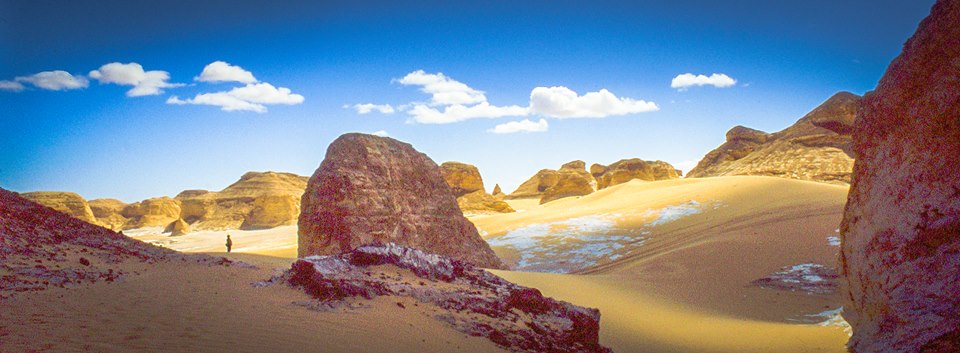
Above me is ‘The Collapsed Pyramid’, also known as ‘Meidum, the forgotten pyramid of Egypt’. It’s situated about 100km south of Cairo on the west bank of the Nile. Tomb robbers originally dug the shaft I was in some 4,000 years before. They must have been small people because they certainly hadn’t wasted their time making their entrance passage any bigger than was absolutely necessary. Hanging from the ceiling like stalactites were polished knobs of tafla clay that scraped against the back of my head.

Shimmying through the tunnel with a 26-pound video camera was no mean feat. The muscles in my arms began to involuntarily contract with the release of lactic acid, which decreased their capacity to hold the camera steady. I was shooting B-roll from the point of view of a tomb robber making his way into the burial chamber below. Unable to stop my arms from shaking, I paused to rest them and to brush away what felt like a large camel flea scurrying down my forehead. I shook my head wildly, only to crack it against the clay ceiling. Taking a swat at my face, I discovered that it wasn’t a flea, but a droplet of sweat mixed with dust. I was now blinded in one eye which stung with irritation. Great!

I dug the toes of my Doc Martin boots into the soil and pushed forward with a grunt, only gaining a few inches. I paused again to look through the camera’s viewfinder only to discover that the lens had what looked like dirty rice on the front element. How long have I been shooting with that crap on the lens?   

Lifting my head, I promptly cracked it yet again on the tunnel’s pitted ceiling. Cradling the camera with my left hand, I reached with my right to pull some lens tissue from my shirt pocket. The packet of tissue was moist from sweat. If I cleaned the grime with a wet tissue it would only smear into a mucky casserole. I laid the camera down to search for a dry, clean tissue, but grappling with the camera in such a confined space brought only more frustration, scraped knuckles, and bruised knees.

With the lens finally clean, I continued to shoot my progress through the earthy conduit, forcing a layer of Egyptian dirt into the crotch of my pants as I lurched further into the passage. To my surprise, the cool earth mixed with sand didn’t actually feel so bad – refreshing, even – as I wasn’t wearing underwear.

Suddenly, my progress was halted by my belt buckle that had snagged on a rock. I swayed my hips back and forth and lifted my pelvis up to free myself from the stone. I think it’s time for a breather. 

I lay on my stomach and enjoyed the feel of cool soil on the family jewels, turning off the camera to save its battery life. In the darkness I became acutely aware of the aroma of earth mixed with dung, along with the delicate fragrance of diesel fuel as it permeated the passageway. The potpourri of odors came from two Egyptians at the entrance fanning air into the tunnel with torn pieces of cardboard.

‘Should I have stayed in L.A., picking up cushy assignments, shooting another silly sitcom or self-serving award show,’ I thought. ‘No!’ I said aloud, forgetting I was alone in the tunnel. Before leaving ABC, I’d gained a reputation of self-reliance in remote and hostile locations, shooting everything from mountain climbing to extreme sports, and even stunts for ABC’s daytime soap opera, General Hospital. I knew it was time to bail from that life when I was charged by my very own union (NABET) for introducing a new video camera technology: the ‘Betacam’. I became a liability for embracing new technology that would ultimately change broadcasting forever. I faced great resentment for disrupting the status quo; I had passed the point of no return. So, I left my comrades behind with their old ideas – the Betacam became my VIP pass to the wider world. Ultimately, it had brought me to this hole in the ground.

Waiting for me in the corbelled burial chamber below was Dr. Salima Ikram Ph.D., Jeremy Brill, my audio man, and our government escort, Mohammad.

Dr. Ikram was a professor of Egyptology from the American University in Cairo and a Cambridge graduate. Specializing in zoo archaeology (the study of faunal remains left behind when an animal dies or, as Dr. Ikram puts it, ‘road kill from the past’). In the field Dr. Ikram can be found wearing a sky-blue headscarf and large, round Audrey Hepburn-style sunglasses. You would imagine that a woman working in traditional Arab society, in a field dominated by males, would be unnerved or feel intimidated. However, despite her youthful age and short stature, Dr. Ikram has a very sharp tongue and can speak rapid Arabic, delivering what needs to be said like a machine gun.

To make sure her point was always understood she armed herself with a Japanese silk hand fan which she pointed and shook in the face of any man who questioned her knowledge or authority. She’d ventured into ancient tombs and ruins more times than Lara Croft and Indiana Jones combined. We all had a crush on her. She was the real deal.

I groaned and resumed recording as I continued down the tunnel. I reached an old wooden ladder which led to a den below that was about the size of a Mini Cooper’s interior. I climbed down, using one hand to hold the camera and the other to grip the rungs of the ladder. ‘Jiminy Cricket on a crutch! My back is killing me!’

‘What was that, Dave?’ Jeremy asked.

‘Nothing, Jeremy, I’m still shooting.’

Crouched in the den, I filled my lungs with more fine dust and floating orbs. I wiped my brow; I was keenly aware that we had so little time to shoot this segment.

Between the den and the burial chamber was a huge slab of limestone. In the center of the slab was a twenty by twenty-inch aperture chiseled out by the tomb robbers. The beveled cuttings from simple hand tools still looked fresh in spite of their age. Extending my arms out in front of me, I held the camera to document my progress as Dr. Ikram, Jeremy and Mo stood on the other side of the slab, watching me with great amusement as I struggled.

I stopped recording when I reached the crux of the tight squeeze, my progress somewhat hampered by my bubble butt. Handing the camera to Jeremy, I pushed and pulled, finally letting out a loud ‘Aarrgghh!’ as I felt my ass pop like a cork from a champagne bottle when I passed the apex. Finally, I was clear of the aperture. Through into a relatively spacious area, I stood upright for the first time and stretched my back.

Scattered about the hallway, leading into the burial chamber, were huge broken blocks of limestone that the tomb raiders had smashed to gain entry to the tomb. For all their tunnel-digging efforts, their prize was a red granite sarcophagus, the size of a professional snooker table. The sarcophagus probably weighed about three-and-a-half tons and it had been hollowed out for a body without the power tools we have at hand today.

The granite lid had been moved aside slightly. On closer inspection, there was an ancient wooden mallet, about the size of a man’s fist, wedged between the sarcophagus and its lid. The tomb robbers had only needed to reach into the stone coffin to plunder it of its riches.

‘Dave, tell me when to start crawling and I’ll describe what lengths the tomb raiders were willing to go to,’ said Dr. Ikram.

Let me get situated and I’ll give you a cue,’ I said.

‘Okay. But remember, if I have to stop and turn around, you promised not to shoot my bum,’ she said, referring to a pact we’d made before descending into the tunnel.

Everyone bustled into place. Mo stood silently as he waited for instructions on what he should do.  We had so little time – I was hoping that after this take with Dr. Ikram I would have enough time to shoot more B-roll in the tunnel, and particularly the aperture and the burial chamber, without anyone around. Once we wrapped at this location we still had to travel back to the Saqqara Palm Club Hotel to do the ‘talking head’ part of the interview with Dr. Ikram; I just hoped it would be before dark.

I gave Dr. Ikram my spiel: ‘Okay, let’s start on this side of the aperture. I’ll start on you, as you explain who, what, where and how. I’ll then pan over to see Mo enter the aperture and follow him through. You continue to describe the tunnel as we make our way to the exit. I’ll continue to roll tape, so don’t stop. If you have to stop, just start from the top of your description, and in post-production we’ll edit snippets of you walking and talking and we can also add in the B-roll footage.’

I panned round from Dr. Ikram to see Mo crawl through the aperture. As I followed Mo through – BLAM! I smacked my forehead into the top of the opening. It must have made a loud noise because Jeremy looked up.

‘What was that?’ he asked.

‘Aarggh… start… start again,’ I said, not wanting to acknowledge that I’d smacked my head for what must have been the hundredth time.

My shins scraped against the lip of the aperture. I arched my back to support the camera in front of me and pushed with my feet to enter the den. I desperately tried to balance myself on my knees. Kerplunk! In a cloud of dust, the camera and I capsized on the rocky floor of the den.

Dr. Ikram, unaware of my listing condition, continued her narrative. ‘Meidum is thought to have originally been built for Huni, the last pharaoh of the Third Dynasty. It was completed by his successor, Sneferu, who also turned it from a step pyramid to a true pyramid, by filling in the steps with limestone. At the pyramid’s massive base are tons of scattered fragments from the collapsed outer shell that stemmed from Sneferu’s repair job. This is the robbers’ tunnel and this is the way to exit the ‘mastaba’. It’s quite a tight squeeze,’ she added.

‘You can say that again,’ I thought.

After Dr. Ikram passed through the aperture and exited the frame, I panned round, following Mo through the den to the bottom of the ladder.

Dr. Ikram continued: ‘The robbers chiseled through the tafla and in through the stone-built mastaba. There are lots of twists and turns to this whole experience, and it’s very difficult in some places because you have to go down almost on your belly and wiggle like a snake.’          She whispered, ‘You didn’t see my bum, did you?’

‘No, no. I didn’t even look in the viewfinder,’ I replied.

Now that there were four of us in the tiny den, and despite the Egyptians’ efforts to keep us cool, there was very little air circulating. We were all getting tired and cranky, and we had just minutes left to shoot this segment.

I would love to do another pass of B-roll in the tunnel alone.

I reached as high as I could, grabbing for the first rung of the ladder. I pulled myself up with one hand, holding the camera in the other. At the top of the ladder I panned round to catch Dr. Ikram climbing up behind me.

I clambered off the ladder. What was that? It felt like a spider running down the inside of my pant leg. I unclenched when I realized it was just a stream of sand and dirt I’d scooped up earlier. Shaking my legs one at a time, I started to edge backwards as Dr. Ikram walked towards me, describing the tunnel. ‘The tafla is worn and eroded because of the many visitors who have come down recently with their nice electricity. Conveniently for them, they could see exactly what was going on.’

Thud! Again?!

‘Do you want to take a break?’ Dr. Ikram asked.

‘No, I just scraped my head and it bloody hurt. Let’s continue,’ I replied softly, so my audio wouldn’t be picked up on tape.

‘It really is a tight squeeze, and when one finally looks out at the end they can’t help but think, ‘Thank God, at last! Light!’’ she went on.

Pointing my camera towards him, I followed Mo’s silhouette as he exited the tunnel into the blinding light of the Sahara sun. Is this what we see when we die: a bright light at the end of a tunnel, and a shadowy figure greeting us as we make our way to God?

Dr. Ikram tried to finish her description while spluttering on the fine dust. Eventually, we were done.

Mark was waiting for us as we emerged from the tunnel. ‘Okay, guys, we have to do it again, and this time, faster! Dave, you’re leaking. What’s all that sand coming out of your pant leg?’

We all glared at Mark, our mouths open.

‘Just kidding!’ he said.


Though that segment was done our day was not over, we still had Dr. Ikram’s sit down interview to shoot back at the hotel, as well as to review the tapes, clean the equipment, charge the batteries and package tapes for shipment back to the States. We had been in Egypt for six days shooting the History Channel’s ‘Tomb Raiders: Robbing the Dead’ and it had been non-stop since landing in Cairo.

Over the next 24 hours we had to travel back to Cairo where our first priority would be shipping the tapes via DHL to Burbank, California. Then we had to drive to Giza for more B-roll of the pyramids and to find a dynamic location to interview Zahi Hawass, the Chairman of the Supreme Council of Antiquities: his interview would cost about $1,500. It’s not uncommon to pay a fee, but the lines between a proper fee and baksheesh is thin.

After the interview we were scheduled to shoot miscellaneous scenic footage with camels, horses and pyramids – hopefully without tourists in the shot. Traveling back to Cairo from Giza, I would have to strap myself on top of our van to catch moving shots of the countryside and the cityscape after entering Cairo. We were to then check into a hotel for just a couple of hours, where we’d need to unload our gear from the van to take to our room – which we all had to share. In that time batteries would need charging and gear needed packing, which meant cross referencing the carnet to our equipment again.

We called Shmuel Bernstein, our co-producer and fixer in Israel. At the Cairo airport parking lot we had to pay the Egyptian production crew, guides, tourist police and our government watcher, plus bonuses. After discreetly shooting B-roll inside Cairo airport, we were finally free to buy souvenirs, drink espresso and eat whatever we could find in the airport terminal, finally boarding a flight at 10:30 p.m. and flying to Tel Aviv, Israel. There, after clearing customs, drinking coffee and eating old Balance bars, we had to load the camera gear into Shmuel’s suburban and drive for two hours to Jerusalem, where we’d check into the King David Hotel around 2:30 a.m. There, we were to unload the gear and charge batteries yet again and take a three-hour nap, just so we could grab the camera and shoot the sunrise over Jerusalem at 5:34 a.m.

We had all that to look forward to, but not before taking a swig from a warm Fanta and racing back down to the entrance of the tunnel. We had one more pass before Mark officially pulled the plug on this location. I rolled the tape and made my way back to the burial chambers. Now alone, I ran my fingers along the narrow opening of the granite sarcophagus to the 3000 year-old wooden mallet. For a moment I visualized a thriving kingdom by the Nile, via this tangible piece of history.

Conscious of our tight shooting schedule, I quietly exited the crypt, leaving in peace any ancient soul aimlessly roaming the tomb in search of the ‘tunnel of light’ to his God.

*****

Later, the post-production supervisor in Burbank called Mark in the middle of the night to say the footage in the Meidum burial chamber was unusable. They said the recording heads of the camera looked dirty and that there were lots of breaks in the video signal. They said they may be able to salvage only a few seconds of footage of the sarcophagus and the mallet.

Blood seemed to drain from my veins. My pride turned to liquid jelly and I lost my appetite. It was the most dreaded phone call any shooter could get and it was certainly no way to start the day. Perhaps there was a curse of the Pharaohs after all…

*****

Mark and Shmuel were inside the Rockefeller Archaeological Museum where the Israel Antiquities Authority (IAA), Jerusalem Division, was located. Across the street was the north wall of the Muslim Quarter of the old city of Jerusalem. They were discussing the day’s schedule and the implications of a ‘ride along’ on a night patrol with Amir Ganor, Director of the Robbery Prevention Division of the IAA.

Tucked away, at the small of Amir’s back, inside his pants, was a .45 caliber handgun with walnut wood grips; on his belt sat a pouch loaded with ammo clips. How Amir sat comfortably in his unmarked jeep for hours at a time with a .45 was a mystery to me – I wondered if it left a permanent imprint on his buttocks.

We loaded up. In a caravan we followed Amir and his partner driving east through the narrow streets of Jerusalem. As we passed the east wall of the Christian Quarters, we watched as huge tour buses parked on the acutely narrow street to unload a fresh crop of pilgrims at the Jaffa Gate. Near the Citadel of the old city a Hasidic Jewish man, dressed all in black with long curls, insisted on walking down the middle of the road wildly waving his arms. Continuing south we drove by crowded bus stops where quite a few male and female Israeli soldiers with fully automatic weapons hitch-hiked for a ride.

In Shmuel’s suburban the four of us were crammed in amongst anvil cases of camera gear, audio equipment, climbing gear, boxed lunches, two cases of bottled water, assorted tools and mountains of protein bars. With one hand on the steering wheel and the other holding his cell phone, Shmuel talked loudly in Hebrew as he set up the next day’s shoot. Mark, with his long legs, sat behind me as he read from the Tomb Raiders’ production book and glanced occasionally out of the passenger window to take in the sights. From time to time I’d hang the Betacam out of the window, taking travel shots across the horizon.

It had been stop and go for hours as we followed Amir down deserted back roads near the Green Line. We just hoped that the camera mounts were holding steady. The afternoon sun seemed brighter there than in Jerusalem and the air was thick with humidity, making it feel hotter then it really was. The dirt road that we were traveling on was badly rutted from the scars of erosion and potholes that looked like shallow wells. With every plunge into a cavity the anvil cases in the back of the suburban leapt up before swiftly crashing down.

We parked aloft a barren hill overlooking the Palestine Territory; the terrain was very similar to southern California: a desert full of sand structures, prickly pear cacti and brown shrubs that eventually turn to tumbleweed. Jeremy was the first to leap out of the suburban to check the camera that was mounted on Amir’s jeep.

‘Dude, the suction cup is solid and the camera is filthy from specks of bug juice,’ he said.

Grabbing the Betacam and a handful of Balance bars, Mark, Jeremy and I started shooting B-roll immediately. Amir and his partner locked and loaded their automatic weapons in unison, slapping the butt end of their magazines to ensure they were sat correctly. We then proceeded east, towards the Green Line, moving as a unit to Amir’s slow and deliberate pace. Amir continually checked the ground for telltale signs of foot traffic and fresh digging. Twenty minutes into our stroll Amir came upon a freshly-dug shaft.

He pointed to the ground. Dead shrubs surrounded the cut in the earth. The shaft had smooth edges and its width was approximately 1.2m square. Just below the surface, the walls of the shaft were lined with roots that looked like the fingers of skeletons cradling protruding rocks.

‘Here! There is new soil on the edge of the shaft,’ said Amir.

Amir gave his weapon to his partner and took the longest Maglite flashlight I’ve ever seen from his pack. He started to climb down into the vertical shaft, using the freaky skeleton-like fingers as a rope ladder for his descent. At the bottom, he disappeared into a horizontal tunnel that led to a chiseled slit in the wall. Shmuel was very anxious to follow and gave us a detailed commentary on his downward climb, using Amir’s technique. ‘Okay, guys, putting my hands on the edge. I’m using my right foot to step on this rock. Okay, okay, now my left foot on this one and now down to the bottom…’

Once descended, Shmuel asked, ‘Okay, who’s going to be the first one coming down, guys?’

I’d deduced that the Betacam was much too big and heavy to film down the shaft so I grabbed the mini DV camera and started to clean the lens from dust and bug wings.

‘Okay, guys, who’s next?’ Shmuel asked again.

I looked over the edge to Shmuel. He was squatting at conduit points in the opening of the chamber. ‘You see? This was blocking the entrance. They moved the stone a little with a crowbar then broke it here to get in. Okay?’


‘Yeah,’ Mark said. He shimmied feet first into the burial chamber, inhaling as he went through the aperture. There were skulls, bones and shards of stones scattered about the burial chamber that made the ground uneven. Amir sat on some broken ossuaries, shining his flashlight on the ceiling of the tomb; the light it cast made the tomb seem even more eerie.

From above I could hear Mark rustling about as he began shooting. ‘I’m just going to get a close up of the skulls and the bones,’ he shouted.

I heard a thud then a groan. Mark had tripped but luckily, he’d not fallen on any of the bones or ossuaries. ‘I have to be very careful here,’ he said to Amir.

Peering over the edge, I made eye contact with Shmuel and handed him my camera. As I started my descent into the shaft, small streams of dirt and pebbles started raining on Shmuel who took shelter next to the slit. Stepping on the jutting stones I heard the dry ‘skeleton fingers’ crack underneath my boots.

Facing the slit, I saw for myself that the tomb raiders had chiseled their entrance unintentionally in the shape of an open mouth. As I prepared to go feet first I conjured in my mind ancient goddesses with beautiful lips, their power of temptation calling on men to see what lay beyond them.

The aperture appeared to suit those with a waist size 32 or less. Given that I’m a 34 waist, I anticipated a problem.Shmuel started giving me instructions. ‘Da’vid, face the opening and go feet first. Slide and inhale at the same time.’

I slid my right boot then my left boot into the hole leading to the tomb’s tunnel. There was the soft, muffed sound of my pants sliding against the rough stone as my feet fell into the tomb. My knees passed and my thighs followed – which was as far as I got. I was stuck between two worlds. My companions started laughing before cheering me on.

‘Push! Push, Da’vid,” said Shmuel.

From inside the tomb I heard, ‘Dave, there’s a fall of about four feet. Drop!’

There was a scraping noise as my 34 waist and belt buckle tried to shimmy. I’ve been told in the past, during romantic endeavours, that I have ‘a butt like a black man’ – something I’ve always thought of as an attractive asset, but which, in this instance, was a real liability. ‘I think I’m too big, guys,’ I told my audience, ‘I’m wedged in!’

Shmuel was trying very hard not to laugh but a giggle escaped. I too began to chuckle, which was uncomfortable considering the added pressure of stone against my waist.

‘I think I’m going to have to go back!’ I kicked my legs wildly, inhaled and pushed with my arms against the lips of the hole. With a grunt, I popped back out like a newborn baby from its mother, onto the ground up top, creating a small cloud of dust.

              Tilting their heads up to the entrance, Mark and Amir laughed as Shmuel helped me up and slapped – not brushed – my backside, freeing me from the dirt and pebbles that clung to my butt. I stretched my back then pulled up my shirt to find that my stomach wore the physical proof that I’d been stuck. Humility aside, all I could think was that the tomb raiders who had made that shaft obviously didn’t like hamburgers as much as I did. I handed the camera through the small hole to Mark and left him to sort out filming in the tomb.


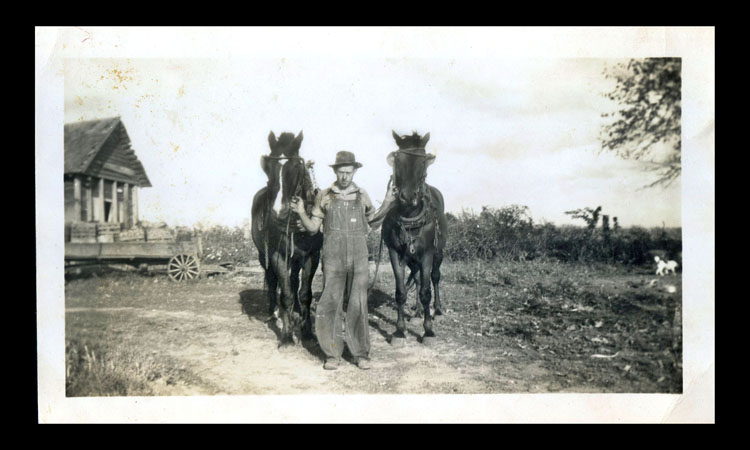
Dad and Missouri Mules009 copy


There is something different about a hand written letter, emails get deleted, greeting cards get lost and phone calls are forgotten with time. But a letter from a loved one is special, maybe it’s because a letter is a tangible artifact of love. In the absents of a departed loved one a letter can be the substitute for holding hands, a hug or a kiss on the cheek. The letter is a reminder of a loving connection that is slowly fading as decades pass by. I carried letters with me when I traveled overseas. Letters that have touched me, letters of encouragement and most of all unconditional love. These letters have pulled me through some pretty hard times.  So, this is an open letter to a man that has given me not only sweet memories of childhood, but by his example showed me how to deal with life on life’s terms with grit and humor.

At the age of five Jasper Paul McWhorter asked a single mother for her hand in marriage which Mary (my mom) accepted and a new family was formed. In spite of the economic hardship of caring for his new family, Paul’s willingness to raise another man child still impresses me to this day. Within the first year of their union, Paul’s earnest effort to provide a secure home and with his sense of humor the bond between a father figure and 5 year old stepson grew and I started calling him daddy.

A veteran of World War II,  he was awarded two Bronze Stars, a Commendation Medal and a Purple Heart. Dad had seen some heavy action in the Philippines but would never talk about his experiences to the point that we could not watch any war movies on TV – which I could not understand until reaching maturaity. Home was on the outskirts of Norht Tulsa off Apache Road near the strip pits and  regardless of the less desireable location dad love his home and took great pride in maintaining the property. With a passion for gardening dad became an expert at growing copious amount of Beefeater tomatoes and on summer days he meditated and problem solved by mowing our yard without a his shirt on – to this day the aroma of fresh cut grass takes me back to those summer days on Quebec Street. After his chores, dads would sit in the backyard on a white metal lawn chair  with his cap pushed back smoking his pipe and drink freshly made lemonade and munching on peanut butter cookies.

My favorite childhood memory of dad is watched him tinker with an Evinrude boat-motor that sat in a steel drum full of water in our backyard. Preparing to start the boat-motor dad would secure his pipe by clinching his teeth, then pushing his glasses up the bridge of his nose and with one mighty pull of the starter rope the Evinrude would sputter. It would take two or three pulls, but once he got it going the blue smoke would fill the backyard and the roar of that Evinrude could be heard throughout the neighborhood. The fumes and smoke engulf dad and all I could see was his pipe sticking out of the blue haze. When the smoke dissipate dad would be standing there with his hand on throttle and for a quick moment I could see in his eyes that dad was far, far away, somewhere on TenKiller Lake or Keystone fishing for bigmouth bass or maybe he was off the coast of Baja fishing for marlin. I’ll never forget that image when the blue smoke cleared.

The word love was not used liberally by dad, but his grandchildren, Jeff and Darla and I knew we were loved when teased with nick names like apple-knocker, eight-ball or curtain-climber. But when dad did get close to saying the words out loud,  “I love you” his voice would crack with emotion as his eyes teared up.

Near the end of dad’s life the Formica kitchen table and vinyl chairs were replaced with a rented gray hospital bed next to the backdoor that lead to his beloved garden. The one room where we gather as a family for meals, games of Monopoly, and frank discussions had become his hospices. It was dad’s wish to end his journey in the home he had worked so hard for. Without the financial means mom’s responsibilities of wife grew greater as the sole caretaker to a man she married so long ago. Before dads final journey, his dementia grew and grew but on this occasion while on the phone he seemed lucid and even cracked joke with me. After sharing the days events and jokes dad handed the phone back to mom. I could hear mom walk away from the kitchen area to the hallway to give me the reality of dad’s condition.

“David, daddy goes in and out of dementia and sometimes he acts as if he is working and asking me for his tools. ” She said.

“I understand mom, just act and pantomime as if your were giving him his tools, okay? Give me a call if anything else come up, just indulge dad, okay? ” I told her.

“Okay dear, I’ll call if anything comes up.” She reassured me.

“Okay mom, love your.”

” I Love you too.”

Three hours later mom calls me back.

“David we just got back, and I wanted to let you know what just happen.” Mom tells me.

“Wait a minute, what do you mean you just got back? I ask out of concern.

“Well, you said to indulge daddy so I did.”

“What”? I asked.

“Daddy thinks he is back on the farm and borrowed two Missouri mules from his neighbors to plow a field, Daddy thinks he didn’t return the mules and seem desperate to return them, so I dressed him in his pajamas, put him in the car and we drove around the neighborhood looking for the mules.”

“Mom!”

“Honey, it got daddy out of the house and you said to indulge him.” she tells me.

“Yes, I did tell you that mom – I tell you what mom, tell dad I’ll go out and look for the mules, okay? Dad may not recall that I live in California.”

“Okay dear.”

An hour late I call home, “Mom, tell dad that I found the mules and returned them to his neighbor.”

“Okay dear.”

I can hear mom hold the phone away and speak in a clear audible voice to reassuring dad.

“Daddy, daddy! David found the mules and returned them to the neighbors.”

Over the phone I can hear dad voice clearly and my heart sank as I heard him say.

“That David, he sure is a good boy.”

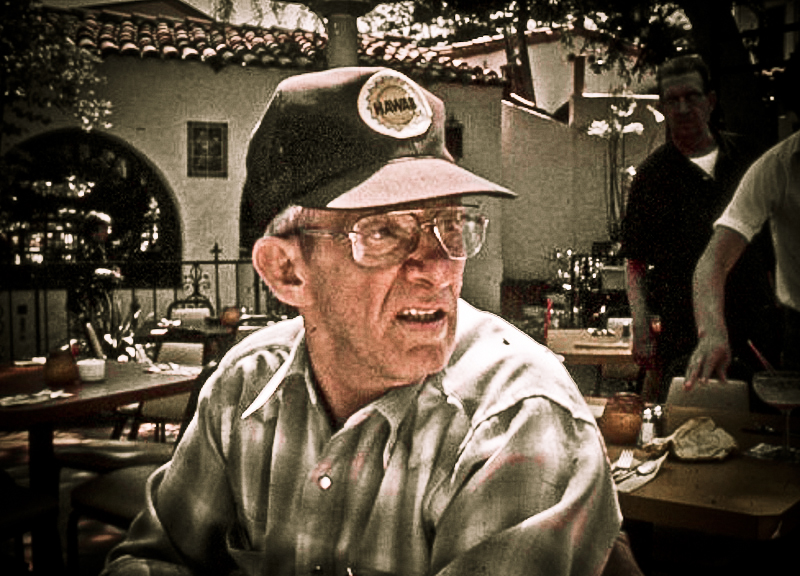
My Dad, PaulThose were the last words I heard from dad as he slipped away into the corridors of his mind. I believe that God puts people in our lives when we most need them. And as a five- year old I desperately needed a good Dad, not a perfect Dad, just a good Dad. Today I am what I am as a result of his influence and example. I know what a work ethic is and the value of humor, thank you dad for giving me those gifts.  Happy Fathers Day Dad, I miss you terribly.


Whitewater WestBeirut L.A., Chapter 4, Cue the Camels Book
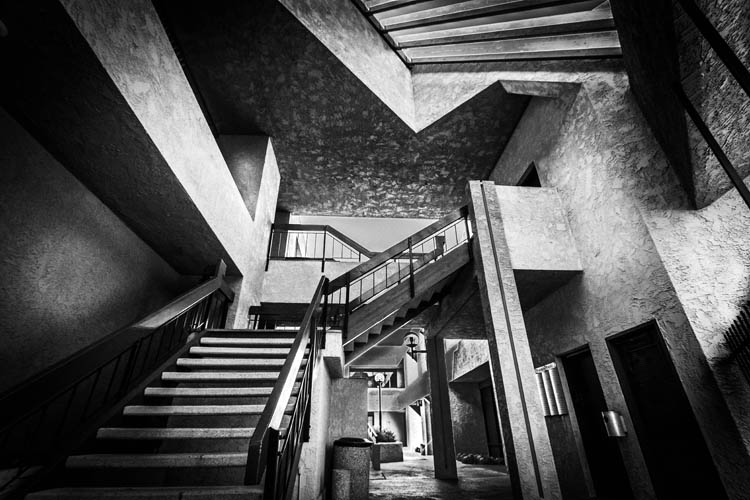
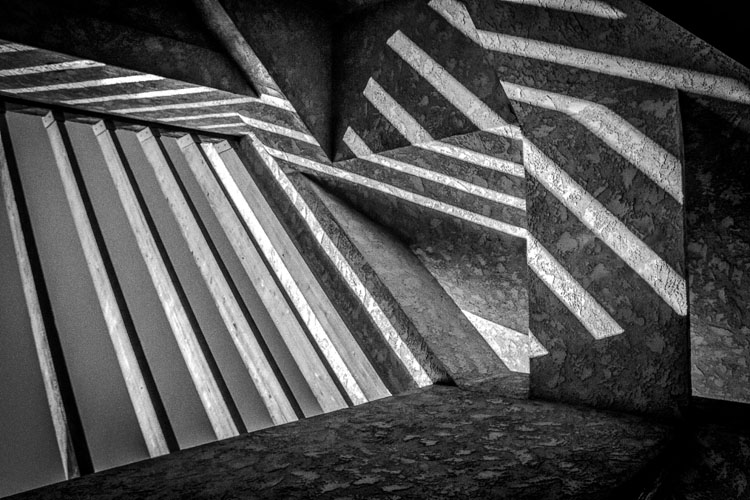
‘Scenes of rape in the arroyo, seduction in cars, abandoned buildings, fights at the food stand; the dust, the shoes, open shirts and raised collars, bright sculptured hair’

~ Latino Chrome lyrics by Jim Morrison, The Doors

Prologue

On April 29, 1992, twelve jurors in Simi Valley, California, delivered their verdicts in a controversial case involving the 1991 beating of Rodney King by four LAPD officers. The case received international attention when grainy footage of the officers’ attack on King was televised and it became a national scandal. The beating would never have been seen had it not been for George Holliday, who grabbed his video camera and stepped onto his balcony when he was awoken by sirens.

The verdict was read: all four officers were acquitted of excessive force and cleared of all charges. Due to the extensive media coverage, the public received immediate news of the verdict. Reaction in Los Angeles was swift as people began venting their anger. L.A. became a scene from a war movie, albeit one far from the facade of a studio.

The following night I picked up an assignment for CBS news to cover film director Spike Lee’s speaking engagement at the University of California in Irvine. The timing was ironic; following the King beating and the LAPD officers’ verdict, it was day two of the rioting. Spike was to talk about his new film ‘Malcolm X’. Irvine is about 45 miles south of Los Angeles, in the county famed for its oranges. Spike never made it; the announcement was made in the UC auditorium that, as a result of an upsurge in violence in L.A. and due to an exodus of traffic causing congestion on the freeways, Mr. Lee was unable to attend his engagement.

I’d taken the precaution of renting an Oldsmobile Cutlass Ciera; my 1978 Volkswagen Bus just didn’t have the speed or the protection for riding around the city of Los Angeles under such challenging circumstances and against brutal violence.

I packed up the camera and rushed back to L.A., heading north on the 405 freeway. It had been closed and was therefore free of traffic by the time I neared Los Angeles International Airport (LAX). With no police scanner to monitor the situation, I listened to KFWB news radio for leads, following police vehicles, helicopters and fire trucks that may have led me to riot hotspots. From their reports, I deduced that the worst fires and looting were taking place in central Los Angeles. At the interchange I took the on-ramp to the Santa Monica freeway that sits high above the ground on concrete columns. This gave me a spectacular view of L.A.’s cityscape – it stretched out before me, hundreds of dark gray smoky plumes spiraling upwards to meet the black sky. I could smell the distinctive stench of burning asphalt shingles, wood and rubber. Jesus! It’s Beirut L.A.

Lingering in the night, like a string of Christmas tree lights, were several police and news helicopters, their distinctive red and green pulsing taillights circling where civil unrest seemed to be worst. Known on the streets as Ghetto Birds, the LAPD helicopters sliced the darkness with their powerful searchlights on fixed points of unrestrained violence as media helicopters converged, scavenging on the carcass of a ravaged city. Above the helicopters were processions of commercial airliners with white lights making their final approach to land at LAX; the passengers looking down below were witnesses to a city gone mad.

Speeding along at 144 k.p.h, towards central L.A., I passed a huge house fire. ‘There’s a man on that roof!’ I shouted to anyone listening. I braked, leaving skid-marks and burnt rubber on the freeway, shifted into reverse and backed up to a suitable point to evaluate the scene. The silhouette of a man with a garden hose looked cartoonish against a wall of yellowy-orange flames. The sound of wood beams splitting from the heat of the fire rang in my ears. I grabbed my camera and rolled the tape, capturing the man as he moved back and forth, dousing the roof with water. I was eighty feet away, but I could still feel the heat as the building cooked.

Mesmerized by what looked like a wasted effort on the man’s part, his hose spraying out little attack towards the ferocity of the fire, I was unnerved by the sound of something whizzing past my ear. I heard the air split wide open as the hissing of a bullet passed by, followed by the sharp cracks of gunshots. I reacted automatically, panning the camera over to where the sounds were originating from when another shot was fired. Shouting began and a car peeled out onto the street below me.  I had no idea if I was the target but I managed to get it on tape. I continued shooting film throughout the night, and it was only when I was filming a mass arrest of looters at a Von grocery store that a voice from behind me reminded me of my vulnerability.

‘You better watch out, cameraman.’

I paused. I didn’t want to press my luck so I packed up and drove to CBS Television City in the Fairfax District and licensed my footage to CBS news. The Oldsmobile, I returned without any damage.

April 30, 1992: President George W. Bush announced that he’d ordered the Department of Justice to investigate the possibility of filing charges against the LAPD officers, for violating the federal civil rights of Rodney King.

August 4, 1992: A federal grand jury returned indictments against Sergeant Stacey Koon and Officer Laurence Powell, both guilty of violating Rodney King’s constitutional rights, with an additional count against Sergeant Koon of willfully permitting the other officers to beat King.

Nearly six months later, on February 25 1993, the trial began in the courtroom of Judge Davies, on the charge of violating the civil rights of Rodney King.

April Fools Day, 1993: Expecting that history would most likely repeat itself, all local, national and international news outlets were gearing up to cover L.A.’s reaction to the verdict. I had been inundated by phone calls from news organizations to cover the event from the end of March. The booking I took was with the A.D. Production Company, the producers of the American Detective show that aired on ABC Network. I was on and off the phone throughout the morning with Mark, who’d produced the riot segment for American Detective.

‘Dave? This is Mark. We’re expecting a verdict soon on the King beating. If the cops are found not guilty there’ll be another riot. If they’re found guilty there may still be a riot. What’s your standby rate if a riot doesn’t happen right away? And do you have a gyro-zoom lens for the helicopter shots?’

Even though we’ve worked together for years, the business of booking has to be clear with very little negotiation; it is pay or play. For my services and for my camera, lighting package and audio gear, it runs to seven hundred dollars a day.

‘Well, Mark,’ I explained, ‘I’ll hold off until another job comes down. There’s no standby rate on my camera package, and yes, I have a gyro-zoom lens.”

There was a pause from Mark. I could hear talking in the background; I must have been on speakerphone.

Mark returned to our conversation. ‘Okay, okay. You’ll be positioned in the Special Enforcement Bureau command center of the Los Angeles Sheriff’s Department, in south-central L.A. You’ve also been given clearance to ride along in their helicopter.’

In my experience, I’ve always found it best not to get too excited about a standby gig, since most inevitably go away on the same day the production companies hire you. This led to the question: ‘Do you want me to ink the date in my diary or shall I use pencil?’

Mark replied, ‘Pencil. By the way, we’ve also hired you a bodyguard for if we reassign you to the streets. If that’s the case, your bodyguard is on the SWAT team of the San Jose Police Department. Oh, and do you have a sun gun light for your camera?’ Mark asked.

Taking notes, I replied, ‘It’s been my experience that a light on a camera makes for a good target.’

‘Oh, good thinking. Okay, we’ll see you on the 12th of April, Monday morning, at the Wyndham Garden Hotel in Commerce. We’ll also rent a bulletproof car, if we reassign you.’

‘How much is that going to cost you?’ I said.

‘A thousand dollars a day.’

I wasn’t surprised – you can rent anything in Hollywood. I called Bexel, the largest vendor of broadcast equipment in the country, to sublease some extra wireless microphones, a gyro-zoom lens and a wide-angle adaptor. I got hold of my friend, John Badovinac, who handled my rental account. ‘JB, this is Dave. Do you have…’ Before I could finish my sentence, John interrupted me.

‘Sorry, Dave, CBS has ten cameras and two gyro-zoom lenses and ABC has just rented what was left on the shelves.’

‘What? This is crazy. This is really crazy!’

‘We’ve rented out everything that has a lens. The networks and local stations are treating this trial as if it was the ‘84 Olympics.’

April 16, 1993: The federal jury convicted Koon and Powell on one charge of violating King’s civil rights. Sergeant Koon and Officer Powell received two and half years in prison. Officer Tony Briseno and Timothy Wind were found not guilty.

April 17, 1993: It was Saturday, 2:30 a.m. I was fully clothed and laid in bed, watching the re-edited version of Dune on television. I munched on another peanut butter Girl Scout cookie and sipped black coffee that was loaded with tons of sugar. I was in a hotel room at the Wyndham Garden Hotel, along with off-duty San Jose detectives and one ex-navy Seal, all of whom had been hired and assigned to me as bodyguards. They were armed to the teeth; the Seal was to drive our rented bulletproof Crown Victoria. Our team had been issued with flak jackets, Kevlar helmets, pepper spray and Israeli gas masks. Ironically, the instructions for the gas masks were in Hebrew which none of us could read.

Though I wasn’t upfront and close to the L.A. riots of 1992, I now had an official backstage pass to the ‘L.A Riots -1993 Tour’.

The decision was made to embed me within the Special Enforcements Bureau instead of a helicopter, in a platoon made up of thirty-six deputy sheriffs. We were to travel in sixteen marked patrol cars and one armored hostage rescue vehicle.

3:15 a.m.: The call came in to prep the gear, check out and travel to a new location. Dammit! Dune isn’t over and I’m going to miss the best part – where the giant sandworms appear to destroy the Harvesters mining on planet Arrakis!

In the hotel lobby I was informed that the production company had had second thoughts; they felt that the thousand-dollar-a-day bulletproof car was too expensive. They didn’t want to be held responsible for any ‘unnecessary’ damage. It looked like I was going to be riding in a deputy sheriff’s patrol car.

8:25 a.m.: We rendezvoused with several other platoons made up of uniformed deputies, in what appeared to be an abandoned hotel parking lot. I looked around the place: I saw some of the deputies relaxing in their vehicles while others paced outside nervously. No one was going to tell me how to behave or exactly what to expect. It was at that moment, as I distracted myself from such thoughts with a fruitless search for coffee, that I heard the verdict and sentencing of the defendants in the second Rodney King trial.

Several of the patrol cars had their trunks open with portable radios tuned to the KFWB news radio. The newscaster’s flat voice echoed across the parking lot, along with news of the war in Bosnia and Herzegovina, a nuclear accident in Russia, a fire-fight with the Branch Davidians in Waco, Texas, and a nifty review of Billy Crystal’s hosting of the 65th Academy Awards.

9:20 a.m.: The platoon relocated to a substation at the City Hall Complex in Lynwood.

11:25 a.m.: This was our first sit-down meal in two days. I was sitting in a plastic molded chair and table that had both been bolted to the floor. This was Angelo’s Burgers, a small fast-food joint at the corner of Imperial Highway and Atlantic Boulevard in Lynwood, California. As I ate my breakfast bean burrito and drank my second cup of coffee, I notice a handmade cardboard sign that had been written on with a magic marker resting on the counter where you placed your order. ‘Falling Down, with Michael Douglas, was filmed here on May 12th, 1992.’

It was at Angelo’s that Michael Douglas’ beleaguered character terrorized a fast-food chain called ‘Whammy Burgers’. I remembered his almost understandable motive for going berserk – the menu had progressed to lunch, and all he wanted was a little breakfast. In short, the movie was about a man in L.A. who went bonkers, so it was ironic that we were in Angelo’s with deputy sheriffs, having breakfast, whilst waiting for a city to go bonkers.


2:15 p.m.: Despite the announcement of the court’s verdict, this wasn’t what saw us race, at top speed, from Lynwood to an amusement park north of Los Angeles. A thousand tickets had oversold at a scheduled rap concert. Not surprisingly, some of the fans were upset and, out of frustration, had shattered the windows of restaurants across the street from the amusement park’s entrance.

4:35 p.m.: Boredom started to kick in. The deputies, our crew and assorted bodyguards were in a holding pattern at the upper entrance to the park. Everyone was hungry. With my supply of Balance bars and gum gone, all I had left was a bag full of Atomic Fireball jawbreakers, which I promptly started to throw at the deputies and production crew, shouting, ‘I’m coming!’

The production company eventually decided to get McDonald’s quarter-pounders for everyone. Halfway through the order, McDonald’s ran out of burgers, so most of the crew and the seventy-plus deputies ended up with Happy Meals. The Happy Meals came in red cartons and inside each was a toy action figure from Batman. A trade-off began between Batman, the Joker and Two Face, though it was Catwoman in her fitted gray costume that proved to be the most coveted.

7:46 p.m.: The sun set. I grabbed the Betacam and my Nikon camera and tagged along with a squad of seven deputies. We took in the sights and sounds of the park and I wondered to myself if we were going to stop long enough to get a corn dog.  Occasionally, families and kids, looking for a way out of the park, stopped us and asked for directions. No one in our group was familiar enough with the park so we weren’t much help.

We’d not been in the park longer than fifteen or twenty minutes when there was a distinct change in the atmosphere. Instinctively, I hoisted the Betacam on my shoulder and removed the lens cap from my Nikon.

There was a lull in the night’s sounds. The normal carnival atmosphere had diminished; where laughter and the excited screams of kids on wild rides had filled the air just minutes ago, there was now just a low hum and relative silence. Something was happening. All of a sudden, there was a new sound – a differently pitched scream travelling through the air. It was a disconcerted screech that built in intensity, continuing until all the laughter had been swallowed. A swelling of emotion rose from my stomach, settling into my chest and heart.

Time seemed to shift then split, both streams working simultaneously. Different scenarios presented themselves in slow motion, while craziness was kicking off in the background in ‘quick time’. I was rolling tape and filming with the camera on my right shoulder while shooting stills using my left hand.

Like locusts swarming upon a field of grain, kids and families poured out of nowhere and surrounded us. The deputies reacted quickly, creating a circle in the middle of a concrete walkway. If you’d have looked down from overhead, you would’ve seen a circle of tan helmets surrounded by a sea of bodies with a sergeant in the middle trying to hear the two-way radio above the noise. One of my eyes was glued to the Nikon’s viewfinder when the camera’s motor drive whined with a ‘click-click-click-click-click’. Framed faces held expressions of dread, concern and confusion as the volume of pandemonium rose to an even higher decibel.

Somewhere in the park ahead of us panic struck like a flash of lightning. We caught the first swell of people seeking safety: a stampede of hundreds barreled right at us. What the crowd needed was a concrete wall, five-feet thick; we were but a mere fence of eight people. The crying, shouting and screaming escalated again. In the distance, ‘snaps’ could be heard. More screams from the stampede.

A deputy shouted, ‘Was that gunfire? WAS THAT GUNFIRE?!’

The mob receded a little, confusion filling the void. The milling crowd looked set to disperse; again, gunshots or firecrackers were heard somewhere in the park. A tidal wave of families, in sheer panic, descended upon us.

Unlike the 1992 riots, what was happening had an element of vulnerability from the families caught in the middle of a total breakdown of civil order. A group of teenage boys and girls ran up to us, screaming that one of the park’s security guys was getting beaten up behind us. We turned but couldn’t see anything other than a wall of bodies a hundred yards deep.

More deputies arrived from nowhere and we made our way across a sea of glass shards, white plastic coat hangers, price tags and paper images of cartoon characters. I filmed the sheriff’s helicopter as it flew overhead, its powerful spotlight shining down on the confused throng, creating massive shadows from the tree limbs and scaffolding which slowly crawled over the entire area like a black web. Looking through the black and white viewfinder the shadow looked ominous – almost alive.

As we passed a restaurant, I noticed that the doors were cracked. I stopped to peer into the darkness. In the foreground were the legs of chairs, tables and serving trays stacked on top of each other. Beyond the barrier a young man, dressed in his chef’s hat and whites, stared at me with a dazed, anxious look. I rested the Betacam on the ground and wedged my Nikon lens between the doors, snapping off a couple of shots. I could only assume that he’d chosen to stand sentry, protecting his co-workers and guests with a fire extinguisher as the world beyond the restaurant door suffered a momentary lapse of sanity.

The park was now quieter as the deputies prodded the visitors, containing them in the main entrance. I passed a long line of kids at a pay phone trying to call their parents to come and get them. Nearby, I saw a marble statue of a rabbit on horseback waving goodbye to its guests.

April 19, 1993: I read that morning in the L.A. Times that the park reopened on Sunday to an enthusiastic spring break crowd as law enforcement officials, park managers and a music promoter tried to pinpoint blame for the melee that damaged both the park and its reputation as a place for family entertainment. An all-night repair job replaced broken windows and a restock of looted merchandise was completed in time for Sunday’s 10 a.m. opening.

I later learned that the ‘confused mass of people’ cost the park an estimated two million dollars in damages. Forty people were evacuated as an emergency, and it took 450 deputies to move 40,000 people out of the park.

Urban legend has it that a body was found underneath the Viper rollercoaster ride four days after the riot.

During the comedown, in showbiz news, there was a big buzz around the release of Steven Spielberg’s film, Jurassic Park, about a team of genetic engineers who created an amusement park full of cloned dinosaurs before all hell broke out. Sometimes, science fiction can be a little too realistic.

Within days I picked up an assignment to the Middle East. As sad as it sounds, I was well prepared.

Epilogue

June 17, 2012: Rodney King, the man at the center of the infamous Los Angeles riots, was found dead in his home in San Bernardino, California. He was forty-seven. According to media reports, King’s fiancée, Cynthia Kelly, found him dead at the bottom of a swimming pool. King recently marked the twentieth anniversary of the riots. Mr. King, whose life was a roller coaster of drug and alcohol abuse, multiple arrests and unwanted celebrity, pleaded for calm during the 1992 riots, in which more than 55 people were killed, 600 buildings were destroyed and the city suffered $1 billion dollars worth of damage.

August, 23, 2012: The autopsy findings by the San Bernardino County Sheriff’s Department, Coroner Division: The effects of the drugs and alcohol, combined with the subject’s heart condition, probably precipitated a cardiac arrhythmia, and the subject, thus incapacitated, was unable to save himself and drowned. There’s nothing in the history or autopsy examination to suggest suicide or homicide, and the manner of death is therefore judged to be an accident.

              “People, I just want to say, you know, can we all get along? Can we all get along? Please….we can get along here.”

– Mr. Rodney King, May 1, 1992

Whitewater West

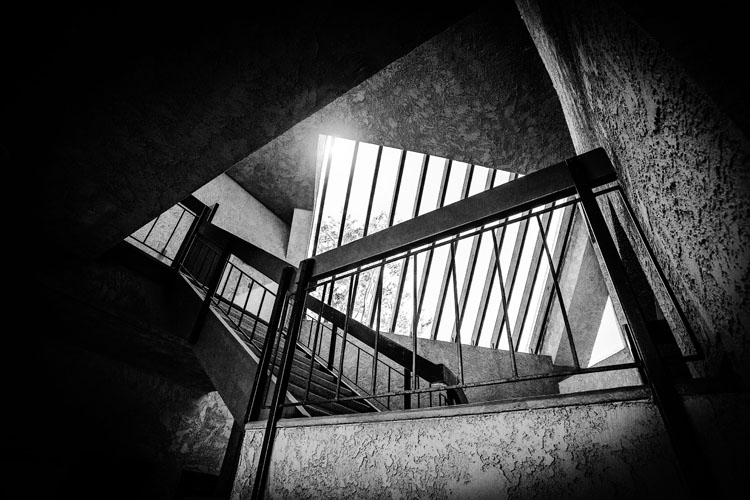
Architectural photography is not my first choice for an assignment; I’m more of a run-and-gun photographer. But from years of overseas and domestic assignments I came to the realization that the kinetic structure of my knees are deteriorating and the pace of my stride is slowing. I live in my past as most men do my age, but reality is insidious and has a way of redirecting ones life. In a conversation with my brother Mark we discussed reinvention, evolution and acceptance as we age. I’ve witnessed him overcome incredible odds in La La Land (Hollywood) to becoming a very successful Producer while all along maintaining his integrity – which is the cornerstone of character. He now lives in the great Northwest freeing his spirit from the tragic and deviant characters of Hollywood. As T.S. Eliot said,

“We shall not cease from exploring,

And the end of our exploring

Will be to arrive where we started

And know the place for the first time.”

How appropriate, only recently has Mark rediscovered his passions that have lied dormant for several decades. One of which is using his hands to build and create – he is the only man I know who has built a home from the ground up.Keystone 0152 Master Email

So what does all this have to do with Architectural photography? My assignment was to photograph an older building that is being refurbished, redecorated and rehabilitated. While editing the images I suddenly became aware of the building name, Keystone, which is the central stone at the summit of an arch locking the whole together. I think of the camera as my cornerstone, holding my perception of the world together with its steel, plastic and glass.Keystone 0062 Master Email

I have heard that Architecture is like frozen music and is assembled in light that fills an empty space. So, are we architects of our own life? We lay our foundation in youth with education and life experiences as we try desperately to avoid the pitfalls as we whimsically journey to completion. It becomes apparent as we age to measure the space and spiritual dimensions of our past, the games we played and the poetic inventions of our heart. For some of us, we did this without a blueprint and struggled, but quickly learned that for every new situation and issue requires new architecture. Unlike Rip Van Winkle who wakes from the glassy bosom of Ale to find that twenty years have past, I woke to reinventing with a solid foundation to breaking new ground.Whitewater West

The first time I saw my name in print was not on a “Hello My Name Is” sticker but in the American Alpine Journal on climbing accidents in North America. Which was not the kind of publicity I needed, after all I was the go to guy for remote and hostile location media work.

           123530_13018_M

California, Yosemite Valley, Half Dome Route

On June 4, 1988, at 1200 hours, Yosemite’s ranger dispatch received a call from Wesley Walton concerning an injured climber on Half Dome……that was me, I was the injured climber. Walton had brought his CB walkie talkie via talked with people on top of Half Dome by 

Dave climbing Half Dome
me and my 80’s porno mustache

CB radio. At 1215 hours, six search and rescue climbers were flown to the top of Half Dome starting at 1330 hrs. At 1443 hrs, Kevin Brown arrived at Big Sandy Ledge after being lowered 150 meters from the summit of Half Dome. He met David Banks, who had an uncomplicated injured elbow, bruised seriously enough so the he could not climb. Banks was raised the 150 meters arriving at 1545 hrs. Brown, Klotz (Banks climbing partner) and two Half Dome climbers who had helped jummarred out. All rescuers were flown out, ending at 1847 hrs.

Ranger Horner interviewed Banks later. He said that he had injured his arm/ elbow  (After x-rays I learned that I had shattered my left elbow) in a slow, sliding fall on the pitch below Big Sandy on June 3. He was slightly off route and did not protect well. He fell about ten meters (about 33 ft.) and stopped prior to hitting a larger ledge. Banks was lowered to his belayer and then Klotz led the pitch to Big Sandy. Banks took an hour and a half to jumar to the pitch, which he did in a lot of pain. They were also hauling the largest haul bag ( which we referred to as the “Pig”) anyone can remember seeing. (Source: Dan Horner and Bob Howard, Rangers, Yosemite National Park)

Whitewater WestAnalysis: Banks and Klotz had each been climbing for several years, led at the 5.3-5.10 level, but had little wall experience. They had brought too much hardware and other gear, and their huge haul bag and lack of experience hauling meant long, tiring days. They were on schedule but had underestimated their daily food and water requirements by about half, however; and by time of the accident they were tired, hungry and dehydrated. In retrospect, they felt their condition made an accident “only a matter of time.” Two points:

By their own admission, they had too much gear; that’s not an argument for taking nothing.

To Be Continued…..

Part One

Dave Banks discusses and signs Cue the Camels
Jay Leno says, “Within these pages Dave has written gung-ho, self-deprecating, wildly engaging accounts of his exploits, with all the behind-the-scene high-jinks that go into shooting news and documentaries across the world.” In Cue the Camels, Dave shares his misadventures in a comedic style that is sure to entertain.

Vroman’s Bookstore Link: http://www.vromansbookstore.com/local629

 Cue The Camels available atwww.cuethecamels.com, www.oodlebooks.com,  Also available at: Vroman’s Bookstore in Pasadena, California www.vromansbookstore.com/book/9780957438385, , Book Soup in Hollywood, California,  booksoup.com/book/9780957438385 , Amazon Kindle Edition: http://www.amazon.com/Cue-Camels-three-time-award-winning-film-maker-ebook/dp/B00IA10Z88/ref=sr_1_1?s=books&ie=UTF8&qid=1403461103&sr=1-1&keywords=cue+the+camels